Chip shrinkage — the difference between expected and actual chip inventory — represents one of the most significant controllable losses in casino operations. Industry estimates place annual chip shrinkage at 1-3% of total chip inventory value across the average casino, translating to losses of $50,000 to $500,000 per property annually depending on size and chip volume. Traditional loss prevention approaches rely on manual observation, periodic counts, and surveillance review, but these methods cannot prevent shrinkage in real time. RFID-equipped gaming tables address chip loss at its source, providing continuous monitoring, immediate detection, and actionable intelligence that dramatically reduce shrinkage across the casino floor.
Understanding Chip Shrinkage Sources
Chip shrinkage originates from several distinct sources, each presenting different prevention challenges:
**Unintentional chip loss** accounts for approximately 40% of total shrinkage. Chips fall off tables, become mixed into discarded chip stacks, or get swept into waste containers during table cleaning. These losses are typically small — one or two chips at a time — but accumulate significantly over months of operation.
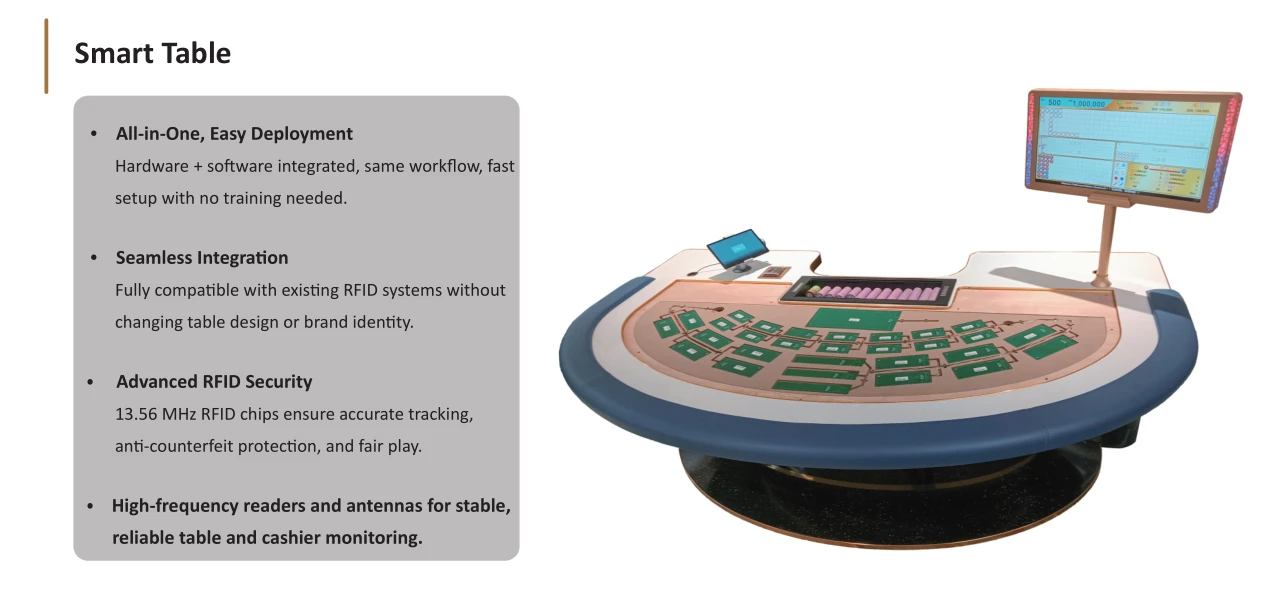
**Dealer error** contributes another 30% of shrinkage. Dealers may miscount payouts, overlook chips during collection, or incorrectly record chip movements. Errors increase during busy periods, high-limit games, and shift changes when dealers are under time pressure.
**Internal theft** — including chip embezzlement by staff and player collusion with dealers — represents approximately 20% of total shrinkage. This category includes schemes such as “chipping” (secretly removing chips from play), “float” (passing chips between player and dealer without game action), and “short pays” (paying a player less than the correct amount and keeping the difference).
**External theft** — including counterfeit chips and player cheating — accounts for the remaining 10%. Counterfeit chips have become increasingly sophisticated, and even experienced cage staff can miss well-made fakes.
RFID tables address all four shrinkage sources simultaneously by creating a complete, real-time record of every chip movement on the gaming floor.
Real-Time Chip Monitoring
The most immediate benefit of RFID tables is real-time chip monitoring. Every chip that enters or leaves a betting zone is read, identified, and logged with a timestamp. When a chip moves from the table to the dealer’s tray, the system records the movement. When the dealer places chips in the drop box, the system records the movement again. The result is an unbroken chain of custody from the moment a chip enters play until it returns to the cage.
This monitoring prevents unintentional loss in several ways. First, the system immediately flags chips that disappear from expected zones. If a player’s chip stack drops below the expected count without a corresponding movement to another zone, an alert is generated. Second, the system’s data enables rapid recovery of accidentally lost chips. When a chip is discovered in a floor sweep or waste container, its last-known location and timestamp can be retrieved from the database, identifying how and when it was lost.
The monitoring also serves as a powerful deterrent. Dealers and players who know that every chip movement is recorded are significantly less likely to attempt theft or manipulation. Surveillance teams can access RFID data in real time, comparing it against video feeds to verify that chip movements match the game action.
Payout Accuracy and Dealer Error Reduction
Dealer error in payouts is one of the largest single sources of chip shrinkage. On a fast-paced baccarat or Niu Niu table, a dealer may resolve 60-100 betting decisions per hour. Even with a 99% accuracy rate, 1-2 errors per hour accumulates to significant daily variance.
RFID tables eliminate dealer payout errors by providing real-time payout calculations. When a round resolves, the system calculates the exact payout based on the chips sensed in each betting zone and the game result entered by the dealer. The calculated payout displays on a dealer-facing screen, allowing the dealer to verify before distributing chips.
This approach catches two types of errors. Underpayment errors — where the dealer pays less than the correct amount — are identified immediately because the system displays the full calculated payout. Overpayment errors — where the dealer pays more than the correct amount — are caught because the system flags any chip movement that exceeds the calculated payout amount.
Casinos that have deployed RFID tables report 40-60% reductions in dealer payout errors, with the largest improvements occurring on high-limit tables where payout amounts are largest and the impact of errors is most significant.

Chip Float and Internal Theft Detection
Chip float schemes — where a dealer passes chips to a confederate player without a corresponding game action — are among the most difficult internal theft methods to detect through traditional surveillance. The chip float occurs in a fraction of a second, and the dealer and player coordinate their actions to avoid detection.
RFID tables detect float schemes through anomaly detection algorithms. The system monitors every chip movement and flags any transfer that does not correspond to a valid game action. If chips move from a player zone to the dealer tray but no betting decision is recorded for that player in the preceding round, the movement generates an immediate alert.
More sophisticated detection uses pattern analysis. The system builds behavioral profiles for each dealer and player, tracking metrics such as chip movement frequency, unusual timing patterns, and zone-to-zone transfers that deviate from normal game flow. When patterns suggest potential collusion, the system generates a priority alert for surveillance review.
The detection capabilities extend to short-pay schemes. In a short-pay scheme, a dealer pays a winning player correctly but records a smaller payout in the table’s chip movement log, keeping the difference. RFID tables eliminate this scheme because the system records the exact chips distributed to each player, preventing the dealer from falsifying the payout record.
Counterfeit Chip Detection
Counterfeit chips represent a growing threat to casino revenue. Modern counterfeiting techniques can produce chips that are virtually indistinguishable from authentic casino chips to the naked eye, and even experienced cage staff can be deceived. A single counterfeit chip exchanged for cash at the cage can represent a $100 or $500 loss to the casino.
RFID provides a first line of defense against counterfeits. Every chip issued by a casino carries a unique RFID tag with encoded data that cannot be replicated without access to the casino’s tag encoding system. When a chip is read at the cage or table, the system verifies the tag against the database. Unrecognized tags — or tags with encoding patterns that do not match the casino’s configuration — generate immediate alerts.
The verification happens at multiple points. At the cage window, incoming chips are verified against the database before exchange. At the table, chips entering play are verified before being placed in active zones. The multi-point verification ensures that counterfeits are caught before they can be converted to cash.
Advanced systems use cryptographic authentication in the RFID tags. Tags encoded with encrypted identifiers can be verified through a challenge-response protocol that proves the tag is authentic without revealing the encryption key. This prevents even sophisticated attackers from cloning tags by capturing and replaying the tag data Macaumr Gaming Technology.
Shrinkage Analytics and Prevention Programs
Beyond real-time detection, RFID chip tracking data enables shrinkage analytics that identify patterns, trends, and systemic issues. The system can generate reports on:
– **Table-level shrinkage rates:** Identifying tables with consistently high variance for investigation.
– **Shift-level patterns:** Detecting whether shrinkage is concentrated at specific shift times, suggesting specific staff or player patterns.
– **Denomination analysis:** Determining whether shrinkage is concentrated in specific denominations, indicating targeted theft or handling issues.
– **Variance trending:** Tracking shrinkage over time to measure the effectiveness of loss prevention initiatives.
These analytics transform loss prevention from a reactive function — responding to discovered incidents — into a proactive program that identifies and addresses systemic vulnerabilities before they result in significant losses.
Return on Investment for Chip Loss Prevention
The ROI case for RFID loss prevention is compelling. A property with $10 million in active chip inventory experiencing 2% annual shrinkage loses $200,000 per year to chip loss. Even a 50% reduction in shrinkage — achievable through RFID deployment on high-limit and high-traffic tables — saves $100,000 annually. For larger properties with higher chip volumes, the savings scale proportionally.
The investment in RFID tables includes hardware (antenna arrays, sensor boards, readers at each table), software (inventory and analytics platforms), and staff training. For a 50-table property, total deployment costs typically range from $1.5 million to $2.5 million, with annual maintenance and support adding $150,000 to $250,000. At a 50% shrinkage reduction rate, the payback period is 18-24 months, with ongoing annual savings that significantly exceed ongoing costs.
Frequently Asked Questions
How quickly can RFID tables detect chip loss compared to traditional methods?
RFID tables detect chip loss in real time — within seconds of the loss occurring. Traditional methods typically discover chip loss during periodic counts, which may occur daily, weekly, or monthly depending on the casino’s procedures. By the time a traditional count reveals a variance, the chips are long gone and the opportunity for immediate recovery has passed. RFID detection enables immediate response, including locking down tables and interviewing staff before the chips leave the property.
Can RFID systems distinguish between chips that are lost versus stolen?
The system records the exact chain of custody for every chip. If a chip moves to an unauthorized location — such as an exit or an employee’s personal bag — the system logs the movement and generates an alert. This enables security teams to respond immediately. For chips that are simply lost (dropped on the floor, swept into waste), the system provides last-known location data that can support recovery. The distinction between loss and theft is determined by the movement pattern, not by the system itself.
Does RFID eliminate the need for physical chip counts?
Physical counts remain a compliance requirement in most jurisdictions, but RFID technology transforms how they are conducted. The RFID system provides a continuous count that can be verified against the physical count. Discrepancies between the RFID count and the physical count indicate either RFID system issues (which can be diagnosed and corrected) or physical count errors. Over time, casinos report that the need for full physical counts diminishes as RFID data provides continuous confidence in inventory accuracy.
What is the typical shrinkage reduction achieved after deploying RFID tables?
Casinos deploying RFID tables report shrinkage reductions of 40-70%, with the variation depending on the property’s prior shrinkage levels, the scope of deployment (high-limit only vs. full floor), and the maturity of the analytics program. Properties with higher prior shrinkage see larger initial reductions. As the analytics program matures and loss prevention processes are refined, shrinkage rates typically stabilize at 60-80% below pre-deployment levels.
Can RFID systems prevent chip loss from player cheating, such as edge sorting or past posting?
RFID systems address chip-related cheating but not all forms of player advantage play. Edge sorting (manipulating card orientation) and past posting (adding bets after outcomes are known) are card-handling issues that RFID does not directly address. However, RFID does prevent chip-related cheating such as surreptitious bet increases and chip stripping, which are often combined with other advantage play techniques. The comprehensive approach of RFID — combined with traditional surveillance and game protection — creates a defense-in-depth strategy.