All posts by john

RFID Casino Table Tracking: How Real-Time Chip Monitoring Transforms Gaming Operations

The casino industry has always operated at the intersection of high stakes and high precision. Every chip on every table represents real monetary value, and the ability to track, monitor, and manage that value in real time is no longer a luxury—it is a fundamental operational requirement. Radio Frequency Identification (RFID) technology has emerged as the definitive solution for casino table tracking, delivering unprecedented visibility into chip movement, table performance, and overall gaming floor dynamics.

This article explores how RFID-enabled real-time chip monitoring transforms gaming operations, from the individual table level to enterprise-wide analytics, and why forward-thinking casino operators are adopting this technology at an accelerating pace.

The Core Problem: Blind Spots in Traditional Table Management

For decades, casino table management relied on manual processes that were inherently slow, error-prone, and limited in scope. Pit managers conducted periodic chip counts, supervisors logged transactions by hand, and floor-level analytics were assembled from disparate data sources that rarely aligned in real time. These traditional methods created significant operational blind spots:

Delayed reconciliation: Chip counts were performed at shift changes, meaning discrepancies could go undetected for hours, giving bad actors ample time to exploit gaps.
Inaccurate float tracking: Manual float sheets depended on human transcription, introducing errors that cascaded through accounting systems.
Limited table-level visibility: Without real-time data, management could not identify which tables were underperforming, which dealers had unusual variance patterns, or which game types attracted the most chip velocity.
Reactive rather than proactive oversight: Problems were discovered after they occurred, not as they were happening.

These blind spots carried direct financial consequences. Unexplained chip variances, slow dispute resolution, and inefficient float allocation all eroded profitability and compliance readiness.

How RFID Table Tracking Works

RFID casino table tracking operates through a layered system of hardware and software that integrates seamlessly into existing table game infrastructure.

Embedded RFID Tags in Chips

Each casino chip is manufactured with an embedded RFID microchip and antenna. The tag stores a unique identifier that corresponds to the chip’s denomination, color, series, and issuance batch. Modern RFID tags used in casino chips are passive—they do not require a battery and are activated only when they come within the read range of an external antenna. This ensures longevity and reliability across years of daily use.

Table-Embedded Antennas

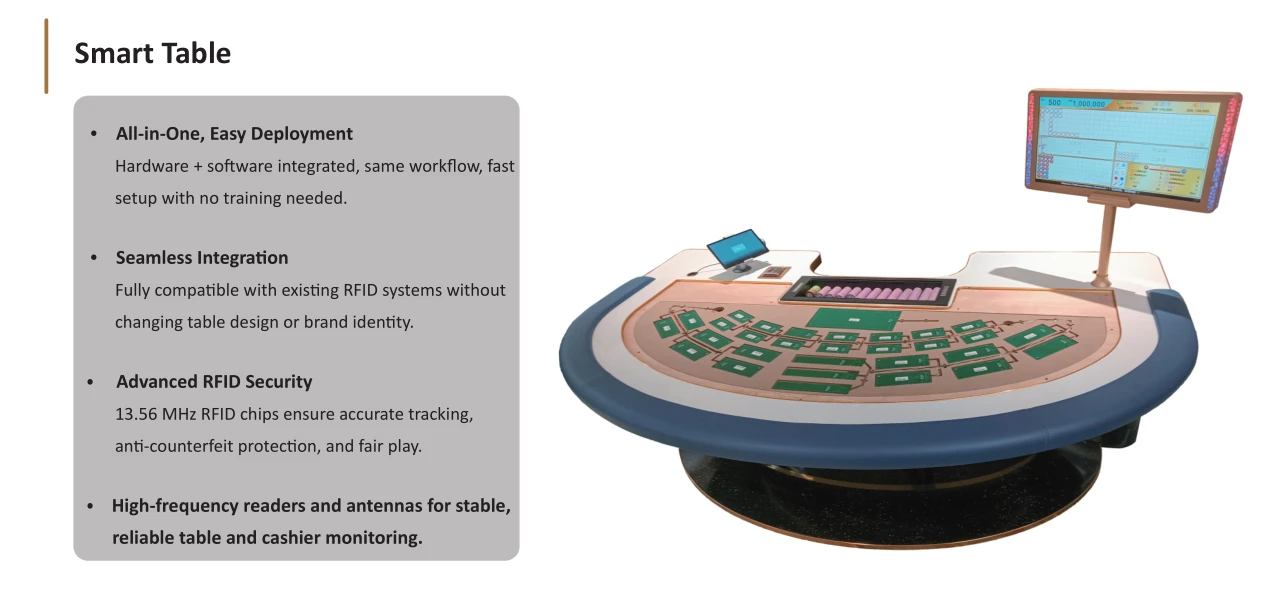
RFID reader antennas are installed beneath the felt surface of gaming tables. These antennas create a read zone that covers the entire playing area, including the dealer’s chip tray, the betting positions, and the cash drop zone. When chips are placed on the table—whether in the tray, on a betting spot, or stacked in front of a player—the antennas detect and identify each chip in real time.

Real-Time Data Processing

The antenna data feeds into a reader unit connected to the casino’s central monitoring system. Every chip movement on every tracked table is logged continuously: chips entering the dealer tray, chips wagered at each position, chips paid out as winnings, and chips removed from the table. This data stream enables live dashboards, automated alerts, and historical analytics without any manual intervention.
RFID Casino Table Tracking Real Time Chip Monitoring

Integration with Casino Management Systems

The RFID tracking layer integrates with existing casino management platforms, player tracking systems, and accounting databases. This means chip-level data enriches player behavior analytics, table performance metrics, and financial reconciliation workflows—all without requiring operators to maintain separate data silos.

Operational Benefits of Real-Time Chip Monitoring

The transformation from periodic manual tracking to continuous RFID-based monitoring delivers benefits across every dimension of table game operations.

Continuous Float Verification

With RFID table tracking, the chip float on every table is verified continuously—not just at shift boundaries. The system knows exactly how many chips of each denomination should be present at any given moment, and any discrepancy triggers an immediate alert. This eliminates the window of vulnerability that manual processes left open and reduces variance investigation from a hours-long exercise to a seconds-level response.

Live Table Performance Analytics

Real-time chip monitoring enables a new category of table performance metrics that were previously impossible to calculate with any accuracy:

Chip velocity per table: How quickly chips move through a given table, indicating game pace and player engagement levels.
Denomination distribution trends: Which chip values are most active at specific tables, informing float optimization decisions.
Hold percentage by position: Actual hold rates calculated from real chip movement data rather than estimated from hand counts.
Peak activity windows: Precise identification of when each table reaches its highest chip volume, enabling optimal staffing allocation.

These metrics allow operations managers to make data-driven decisions about table layout, float sizing, game mix, and staffing—decisions that directly impact revenue per table and per square foot of gaming floor space.

Enhanced Dealer Accountability

RFID table tracking introduces a layer of objective, automated oversight into dealer operations. The system records every chip transaction tied to a specific dealer and timestamp. This data supports:

Variance pattern analysis: Identifying dealers whose tables consistently show unusual chip movements, enabling targeted training or investigation.
Transaction accuracy verification: Confirming that payouts match wager outcomes without requiring a supervisor to physically observe every hand.
Performance benchmarking: Comparing dealer speed, accuracy, and table hold rates against objective standards derived from real data.

This does not replace human supervision—it augments it. Pit managers and supervisors can focus on customer service and game protection while the RFID system handles the data collection that previously consumed their time.

Rapid Dispute Resolution

Player disputes over chip counts, bet amounts, or payout accuracy are among the most time-consuming incidents on a gaming floor. RFID table tracking resolves many of these disputes instantly. When a player claims they wagered a different amount or received an incorrect payout, the system can retrieve the exact chip transaction log for that table, position, and time window. The data is objective, timestamped, and tamper-resistant—providing an authoritative record that both the player and the operator can trust.

Float Optimization Across the Floor

One of the most impactful operational benefits is the ability to optimize chip float distribution dynamically. Traditional float management relied on experience and rough estimates—placing a certain number of chips on each table based on historical patterns and supervisor judgment. RFID tracking replaces this with data-driven float allocation:

– Tables with high chip velocity receive appropriately sized floats to avoid interruptions for chip fills.
– Tables with low activity receive reduced floats, freeing chip inventory for higher-demand positions.
– Denomination mix is adjusted based on actual usage patterns rather than assumptions.

Optimized float distribution reduces the frequency of chip fills and credits, minimizes the labor cost of float transfers, and ensures that every table is always ready to accept wagers at the level its players demand.

RFID Casino Table Tracking Real Time Chip Monitoring

Compliance and Regulatory Advantages

Regulatory bodies across major gaming jurisdictions increasingly expect—or require—operators to demonstrate robust chip accountability. RFID table tracking directly addresses several regulatory priorities:

Audit Trail Integrity

Every chip movement on every tracked table is logged with a timestamp, reader ID, and chip identifier. This creates an unbroken, machine-generated audit trail that satisfies regulatory requirements for transaction documentation far more comprehensively than manual logs.

Variance Reporting Accuracy

Regulators require timely variance reports, and RFID systems generate these automatically. Discrepancies are flagged and documented at the moment they occur, not at the end of a shift when context has faded and evidence has degraded.

Anti-Money Laundering Support

RFID chip-level data supports suspicious activity detection by tracking chip movements that deviate from normal patterns—such as unusually large chip accumulations at a single position, rapid movement of high-denomination chips between tables, or chip volume patterns inconsistent with observed wagering behavior.

Regulatory Examination Readiness

When regulators conduct examinations, RFID-enabled operators can produce detailed, system-generated reports covering any table, any time period, and any chip denomination within minutes. This contrasts sharply with the labor-intensive, error-prone manual report compilation that examiners often encounter.

Implementation Considerations

Adopting RFID table tracking requires thoughtful planning across several dimensions.

Hardware Selection

Casino operators must select RFID tags and readers that meet the specific demands of gaming environments—durability under constant handling, reliable read performance through stacked chips, and compatibility with existing chip designs. Working with a leading provider of casino-grade RFID solutions ensures that hardware specifications align with operational requirements.

Table Retrofit vs. New Build

RFID antennas can be retrofitted into existing tables or integrated during new table construction. Retrofitting is typically more cost-effective for properties with established table inventory, while new builds allow for optimized antenna placement and reduced installation complexity.

Data Integration Architecture

The RFID data layer must be integrated with the property’s casino management system, player tracking platform, and financial accounting infrastructure. This integration should be designed with scalability in mind—adding new tables, new denominations, or new data consumers should not require architectural rework.

Staff Training and Change Management

Transitioning from manual tracking to RFID-based monitoring changes daily workflows for pit managers, supervisors, dealers, and accounting staff. Effective implementation includes structured training programs that help staff understand what the system does, how to interpret its outputs, and how to incorporate real-time data into their decision-making processes.

Privacy and Data Governance

RFID tracking generates granular data about player behavior and chip movement. Operators must establish clear data governance policies governing data retention, access controls, and usage boundaries—both to protect player privacy and to maintain regulatory compliance.

The Future of RFID Table Tracking

The trajectory of RFID technology in casino operations points toward several emerging capabilities:

AI-driven anomaly detection: Machine learning models trained on chip movement data will identify suspicious patterns faster and more accurately than threshold-based alerts.
Cross-table player tracking: Linking chip movements across multiple tables to build comprehensive player behavior profiles without requiring manual carding.
Predictive float management: Algorithms that anticipate float requirements based on historical patterns, seasonal trends, and real-time floor activity.
Integrated security ecosystems: Combining RFID chip data with surveillance video analytics, access control logs, and employee tracking to create unified security intelligence platforms.

Operators who establish RFID infrastructure today are building the foundation for these future capabilities. The data pipeline that real-time chip monitoring creates is the same pipeline that next-generation analytics and AI systems will consume.

Conclusion

RFID casino table tracking has moved beyond pilot programs and early adopters into mainstream operational technology. The benefits—continuous float verification, live table analytics, enhanced dealer accountability, rapid dispute resolution, optimized float distribution, and regulatory compliance readiness—are compelling and quantifiable. For operators evaluating their next technology investment, RFID table tracking represents not merely an upgrade to existing processes but a fundamental transformation of how table game operations are monitored, managed, and optimized.

FAQ

How does RFID table tracking differ from manual chip counting?

Manual chip counting occurs at discrete intervals—typically at shift changes—and depends on human observation and transcription. RFID table tracking operates continuously, detecting and logging every chip on the table in real time without manual intervention. This eliminates counting errors, reduces variance detection time from hours to seconds, and provides live data for operational decision-making.

Can RFID read through stacked chips on a table?

Modern casino-grade RFID readers are designed to read through stacks of chips. The antennas embedded in table surfaces detect individual chip tags even when chips are stacked in the dealer tray or in player positions. Leading providers have refined antenna geometry and read algorithms specifically to handle the stacking patterns common in live table game environments Macaumr Gaming Technology.

Does RFID table tracking slow down game pace?

No. RFID tags in chips are passive and require no action from dealers or players. The antennas beneath the table felt read chips silently and continuously without any change to game procedures, dealer routines, or player experience. The tracking layer operates invisibly alongside normal game play.

What happens if a chip’s RFID tag stops working?

RFID systems include exception-handling protocols for unreadable chips. When a chip fails to register, the system flags the anomaly and prompts a manual verification step. Most leading systems also support periodic tag health checks, allowing operators to identify and replace degraded chips before they cause tracking gaps.

Is RFID table tracking required by gaming regulators?

Regulatory requirements vary by jurisdiction. Some regulators mandate chip tracking technology for specific operations or chip denominations, while others encourage adoption through compliance incentives. Regardless of mandate status, RFID tracking significantly simplifies regulatory reporting and examination preparation, making it a strategic investment even in jurisdictions where it is not yet required.

How long does it take to implement RFID table tracking across a casino floor?

Implementation timelines depend on the scope of deployment, the condition of existing tables, and the complexity of data integration. A phased rollout—starting with high-value tables and expanding progressively—is typically completed over several months. Leading providers offer implementation support that includes hardware installation, software configuration, integration testing, and staff training.

Can RFID table tracking integrate with existing casino management systems?

Yes. RFID tracking platforms are designed with open integration architectures that connect to standard casino management systems, player tracking databases, and accounting platforms. The integration delivers chip-level data to existing workflows without requiring operators to replace their core operational software.


Poker Analyzer Legal Considerations Around the World

The poker analyzer market operates within a complex and fragmented global legal landscape. Operators, distributors, and serious buyers of infrared and barcode-scanning poker prediction devices must understand that legality varies dramatically across jurisdictions. This article provides a comprehensive technical and commercial legal overview for professionals evaluating the acquisition and deployment of poker analyzer systems, including AKK, CVK, and CAC series devices, barcode marked cards, and associated infrared earpiece communication systems.

Understanding the Legal Framework

The legal status of poker analyzer technology is not determined by the device itself but by the context in which it is used. In most countries, the core technology—infrared scanning, barcode reading, and predictive algorithm processing—has legitimate applications in security, logistics, and data processing. It is the application of this technology to gambling environments that triggers regulatory attention.

Gambling regulations generally fall into three categories: fully regulated, partially restricted, and outright prohibited. In fully regulated markets such as the United Kingdom, Australia, and many parts of Europe, gambling operators are subject to strict licensing requirements. The use of any device that provides an unfair advantage—commonly referred to as cheating devices—constitutes a criminal offense regardless of whether the operator holds a gambling license. The UK Gambling Commission’s framework explicitly prohibits devices that determine the outcome of a game or assist in predicting results, placing poker analyzers squarely in regulated territory.

In partially restricted markets, legislation may be ambiguous or inconsistently enforced. Countries such as India, where gambling laws vary by state, create a patchwork of regulations that can make the legal standing of poker analyzer possession and use unclear. Operators in these regions must conduct jurisdiction-specific due diligence before acquiring or deploying equipment.

Regional Legal Breakdown

North America

In the United States, the Wire Act and the Unlawful Internet Gambling Enforcement Act (UIGEA) govern interstate gambling transactions, but individual states maintain sovereignty over gambling regulation within their borders. Nevada, New Jersey, and Pennsylvania—major regulated gambling states—criminalize the use of cheating devices with specific statutes targeting devices that manipulate game outcomes. Federal law under the Computer Fraud and Abuse Act may also apply to electronic devices used to gain unauthorized advantage.

Poker Analyzer Legal Considerations Around World

Canada’s Criminal Code classifies cheating at gambling as an indictable offense, with penalties that can include imprisonment. The Canadian framework treats possession of devices designed for cheating with the same severity as their actual deployment.

European Union

Within the European Union, member states maintain divergent gambling regulations despite efforts toward harmonization. Germany, following its 2021 Interstate Treaty on Gambling, enforces strict penalties for cheating device possession in licensed establishments. France’s Autorité de régulation des jeux en ligne (ARJEL) imposes equivalent restrictions. In contrast, some smaller EU jurisdictions have historically demonstrated limited enforcement capacity, though this is rapidly changing with increased cross-border cooperation among regulatory bodies.

Asia-Pacific

The Asia-Pacific region presents the most varied landscape. Macau, the world’s largest gambling market, treats cheating device possession as a serious criminal matter under its Penal Code, with operators facing license revocation and individual actors facing imprisonment. Singapore enforces its Remote Gambling Act with strict prohibitions, while the Philippines’ PAGCOR framework regulates but does not authorize advantage-play devices.

Emerging Markets

In Latin America and Africa, gambling regulation is evolving rapidly but remains inconsistent. Brazil’s regulated market framework does not yet fully address electronic cheating devices, though general fraud statutes apply. South Africa’s National Gambling Act prohibits devices that manipulate outcomes, though enforcement is concentrated in major urban centers.

Criminal vs. Civil Liability

Understanding the distinction between criminal and civil liability is essential for any organization or individual involved in the poker analyzer supply chain. Criminal liability attaches to the actual user of the device in a gambling context. Distributors and manufacturers may face accessory charges, conspiracy allegations, or trafficking offenses depending on the jurisdiction and the nature of their involvement.

Civil liability may arise from breach of contract, particularly in tournament settings where participants agree to rules prohibiting advantage devices. Tournament organizers have successfully pursued civil damages against players caught using analyzer systems.

Due Diligence Recommendations for B2B Buyers

Professional buyers evaluating poker analyzer technology for legitimate research, law enforcement, or regulatory compliance testing purposes should:

1. Verify jurisdictional legality in the final destination country before acquisition and again before deployment
2. Obtain written legal opinions from qualified attorneys in relevant jurisdictions
3. Document the intended use case comprehensively, as this may serve as a defense in regulatory inquiries
4. Review import/export regulations, particularly regarding dual-use technology under export control regimes
5. Conduct supply chain audits to ensure components do not violate international sanctions or restricted technology frameworks
6. Maintain equipment provenance records documenting the chain of custody from manufacturer to end user
7. Implement operational security protocols that limit exposure of device specifications and capabilities to unauthorized parties

Import and Export Controls

Many jurisdictions control the export and import of gambling-related technology under broader economic sanctions and technology transfer frameworks. The United States Export Administration Regulations (EAR) classify certain electronic devices and optical sensors that have applications in gambling equipment. Similar frameworks exist in the European Union, Japan, South Korea, and other advanced manufacturing economies.

Poker Analyzer Legal Considerations Around World

Buyers operating across international borders must verify that their procurement and logistics arrangements comply with relevant export and import controls. This includes customs classification of poker analyzer components, end-user certification requirements, and any licensing requirements for transboundary technology transfer.

Anti-Money Laundering Considerations

High-value gambling transactions frequently attract anti-money laundering (AML) regulatory scrutiny. Poker analyzer equipment transactions, due to their typically cash-based and internationally distributed nature, may trigger AML reporting requirements in certain jurisdictions. B2B buyers should maintain thorough transaction records that demonstrate the legitimate provenance of equipment purchases.

International Treaty Obligations

Several international agreements affect the cross-border movement and use of gambling-related technology. The United Nations Convention against Transnational Organized Crime provides a framework under which sophisticated gambling cheating devices may be treated as proceeds of crime or tools used in furtherance of criminal enterprises. Interpol cooperation agreements enable information sharing about known international operators of illegal gambling equipment.

The Financial Action Task Force (FATF) recommendations on anti-money laundering provide guidelines that many countries have incorporated into domestic legislation, creating additional reporting and compliance obligations for transactions involving gambling-related technology. Operators engaged in cross-border procurement should understand how these international frameworks apply to their specific circumstances pokeranalyzershop.com.

Risk Assessment Framework

Professional risk assessment for poker analyzer technology engagement should evaluate:

Jurisdiction-specific legal risks: The applicable laws and regulations in each relevant jurisdiction, including criminal penalties, civil liability exposure, and regulatory enforcement patterns
Enforcement probability: The likelihood of enforcement action based on historical enforcement patterns, current regulatory priorities, and the visibility of the planned operation
Sentencing severity: The potential consequences of conviction, including imprisonment terms, financial penalties, and collateral consequences such as asset forfeiture and professional licensing revocation
Supply chain risk: The legal exposure associated with each participant in the procurement and distribution chain
Reputational risk: The non-legal consequences of association with gambling equipment technology, including professional reputation damage and relationship impacts

This framework should be reviewed annually or whenever there is a significant change in the legal or regulatory environment affecting the relevant jurisdictions.

Technology Classification and Regulatory Loopholes

Certain jurisdictions classify poker analyzer technology under broader categories such as “optical sensors,” “data processing equipment,” or “surveillance technology.” These classifications can create gray areas in which possession of components is legal while assembly into a functional system is not. Professionals should be aware that partial compliance—owning individual components without the complete system—does not guarantee legal standing.

The rapidly evolving nature of gambling regulation means that what is permissible today may become prohibited with minimal notice. Operators should establish ongoing legal monitoring processes rather than treating initial compliance as permanent.

Penalties and Enforcement Trends

Modern enforcement is increasingly sophisticated. Casino surveillance systems in regulated markets now incorporate AI-based anomaly detection that can identify patterns consistent with analyzer device usage—including unusual betting timing, inconsistent player behavior, and statistical deviations from normal game flow. Regulatory bodies in major gambling jurisdictions have established intelligence-sharing agreements that allow information about known cheating device operators to circulate across borders.

Penalties for conviction range from administrative fines in minor cases to criminal prosecution with imprisonment terms exceeding five years in serious jurisdictions such as Macau, Singapore, and the United Kingdom. Supply chain participants face increasing scrutiny, with several major distributors facing prosecution in 2023 and 2024 for knowingly supplying equipment to illegal gambling operations.

Conclusion

The legal landscape for poker analyzer technology demands rigorous compliance discipline from every participant in the supply chain. B2B buyers and distributors must treat legal compliance not as an afterthought but as a foundational element of their business operations. Given the severity of penalties and the speed of regulatory evolution, professional legal counsel should be a mandatory component of any poker analyzer acquisition or distribution strategy.

Frequently Asked Questions

Q: Is it legal to own a poker analyzer for personal research purposes?
A: Possession laws vary by jurisdiction. In many countries, possession of a device designed for cheating at gambling is itself illegal regardless of intended use. Consult qualified legal counsel before acquisition.

Q: Can poker analyzer technology be imported legally?
A: Import regulations depend on both the origin country and destination country. Many nations classify these devices as gambling equipment or cheating devices subject to import restrictions.

Q: Are there any legitimate uses for poker analyzer technology?
A: Legitimate research applications may include academic study of gambling behavior, law enforcement training, and regulatory compliance testing in licensed environments under strict authorization.

Q: What happens if a distributor is found supplying these devices to illegal gambling operations?
A: Distributors may face criminal charges including conspiracy, trafficking in cheating devices, and accessory to fraud, depending on the jurisdiction and evidence of knowledge or intent.

Q: How are enforcement agencies detecting poker analyzer use in casinos?
A: Modern detection methods include AI-powered surveillance analytics, statistical anomaly detection in betting patterns, and increased staff training to identify behavioral indicators of device use.

Poker Analyzer Battery Life and Power Management

Battery performance is one of the most critical operational factors for any poker analyzer system deployed in professional or commercial environments. Whether the device is a dedicated handheld unit or a peripheral module integrated into an existing platform, power management determines uptime reliability, response consistency, and ultimately the confidence of operators in mission-critical scenarios. This article provides a comprehensive technical overview of battery architecture, power consumption patterns, and best practices for managing the power systems of modern poker analyzer hardware.

Modern poker analyzer devices are typically powered by lithium-polymer or lithium-ion cells, chosen for their high energy density, low self-discharge rates, and ability to deliver stable voltage under variable load conditions. The selection of battery chemistry directly influences several key performance parameters, including the device’s operational duration between charges, its ability to sustain peak processing loads during active scanning, and its longevity measured in charge cycles before capacity degradation becomes significant.

Poker Analyzer Battery Life Power Management

Battery Chemistry and Capacity Considerations

Lithium-polymer cells have become the dominant choice in compact poker analyzer hardware due to their form factor flexibility and relatively flat discharge curve. A typical high-capacity lithium-polymer cell rated at 3000 to 5000 milliampere-hours can sustain a poker analyzer device through an eight-hour operational shift, assuming moderate scanning frequency and standard display brightness settings. Devices that integrate continuous wireless transmission or high-frame-rate camera scanning will exhibit measurably higher power draw, often reducing effective runtime by thirty to forty percent under heavy use conditions.

Understanding the relationship between processing load and power consumption is essential for operators who need to plan device deployment schedules. During active scanning operations, when the device’s processor is executing real-time image analysis and the infrared barcode scanner is illuminating marked cards, power consumption can spike to three to four times the device’s idle draw. This dynamic power profile means that battery selection must account for peak load scenarios rather than average operational conditions.

Charging Infrastructure and Cycle Management

Proper charging practices significantly extend the useful life of poker analyzer batteries. Lithium-based cells are sensitive to deep discharge conditions and should never be routinely depleted below twenty percent of rated capacity. Many modern poker analyzer devices incorporate battery management systems that automatically throttle performance or enter a low-power preservation mode when charge levels drop below critical thresholds, but relying solely on these safeguards is not a substitute for disciplined charging schedules portable poker analyzer.

Using manufacturer-specified charging equipment is paramount. Third-party chargers may deliver incorrect voltage regulation or inadequate current limiting, leading to reduced cycle life, potential safety hazards, or inconsistent device performance. Fast charging capabilities, while convenient, generate additional thermal stress within battery cells and should be reserved for situations where rapid turnaround is operationally necessary rather than as a standard charging protocol.

Poker Analyzer Battery Life Power Management

For commercial operators managing multiple devices, establishing a centralized charging station with individually monitored charging bays allows battery health tracking at the fleet level. Battery performance logs maintained over weeks or months can reveal cells that are degrading faster than expected, enabling preemptive replacement before a device fails during active operation.

Thermal Management and Environmental Factors

Temperature exerts a profound influence on battery performance and longevity. Lithium-polymer cells operate optimally within a ambient temperature range of fifteen to thirty-five degrees Celsius. Exposure to temperatures exceeding forty-five degrees Celsius, whether from direct sunlight, prolonged device operation, or inadequate ventilation during charging, accelerates electrochemical degradation and can permanently reduce cell capacity. Conversely, temperatures below freezing can temporarily reduce available capacity and impair the device’s ability to deliver peak current during high-demand scanning operations.

Poker analyzer devices used in outdoor tournament settings or in environments without climate control require particular attention to thermal management. Carrying cases with thermal insulation, shaded operational positions, and scheduled rest periods during peak heat hours all contribute to maintaining battery health and consistent device performance. Some advanced poker analyzer systems incorporate passive thermal management features such as heat-spreading substrates and thermally conductive housings, but these features complement rather than replace environmental awareness on the part of the operator.

Power Management Strategies for Extended Operations

Effective power management extends beyond battery selection and charging discipline to encompass how the device is configured and used during operations. Several operational adjustments can meaningfully extend effective battery life without compromising core functionality.

Display brightness reduction is the single most impactful configurable setting. Reducing screen luminosity from maximum to fifty percent can reduce power consumption by twenty-five to thirty percent, and most poker analyzer interfaces remain fully readable at reduced brightness levels in typical indoor lighting conditions. Disabling unnecessary wireless connectivity features when the device is not actively transmitting data to external displays or recording systems also yields meaningful power savings.

Developing operational protocols that account for power availability ensures that critical moments in a session are never compromised by a device shutting down unexpectedly. Establishing a charge level alert threshold, ideally no lower than thirty percent, provides a safety margin that allows the operator to gracefully conclude active operations and transition the device to charging before capacity becomes limiting.

Battery Monitoring and Diagnostic Indicators

Modern poker analyzer devices typically provide real-time battery status information through their operating interfaces. Voltage readings, remaining capacity percentages, and estimated runtime under current load conditions equip the operator with the information needed to make informed decisions about device deployment. Understanding the difference between nominal voltage and actual remaining capacity is important, as lithium-polymer cells exhibit voltage sag under load that can make state-of-charge estimates less reliable at higher discharge levels.

Advanced battery diagnostic features found in some poker analyzer systems include cycle count tracking, internal impedance measurements, and cell balance monitoring for multi-cell battery packs. These diagnostics enable proactive maintenance by identifying batteries that are approaching end-of-life before they fail in the field.

FAQ

How long does a fully charged poker analyzer battery typically last?
A quality lithium-polymer battery in a modern poker analyzer device typically provides six to ten hours of continuous operation, depending on usage intensity, scanning frequency, and display settings. Heavy scanning workloads may reduce this to four to six hours customplayingcardss.com.

What is the recommended charging practice for poker analyzer devices?
Charge devices when battery levels reach approximately twenty to thirty percent, and avoid leaving them connected to chargers after they reach full capacity. Use only manufacturer-specified charging equipment and avoid fast charging as a routine practice.

How can I extend the battery lifespan of my poker analyzer device?
Avoid deep discharge cycles, keep the device within optimal temperature ranges, reduce display brightness during normal operations, disable unused wireless features, and store devices at approximately fifty percent charge when not in use for extended periods.

When should a poker analyzer battery be replaced?
Replace batteries when they no longer hold their rated capacity, when they swell or exhibit physical deformation, when they discharge significantly faster than previously observed, or when the device powers off unexpectedly despite showing adequate charge levels.

Does extreme temperature affect poker analyzer battery performance?
Yes. High temperatures accelerate battery degradation, while cold temperatures temporarily reduce available capacity and can impair high-current delivery during peak scanning operations. Always operate and store poker analyzer devices within the manufacturer’s specified temperature range.

Linked Progressive Jackpot Systems: Technology That Drives Casino Revenue

Linked progressive jackpot systems represent one of the most powerful revenue-generating technologies in the modern casino industry. By connecting multiple slot machines to a shared jackpot pool, these systems create the possibility of life-changing payouts that no standalone machine could offer independently. The result is higher coin-in, longer player sessions, and a competitive differentiation that drives player acquisition and retention. For casino operators, understanding progressive system architecture, mathematics, and floor strategy is essential for revenue optimization.

How Linked Progressive Systems Work

A linked progressive system operates on a simple but powerful principle: each connected machine contributes a small percentage of every wager to one or more shared jackpot pools. When a player hits the qualifying combination, they win the accumulated pool amount. The system then resets to a predetermined base amount and begins accumulating again.

Linked Progressive Jackpot Systems Technology Drives Casino Revenue

The technical architecture involves a progressive controller — a dedicated server that communicates with each connected machine in real time. The controller receives coin-in data from each machine, calculates the progressive contribution, updates the jackpot display across all linked machines, and monitors for jackpot triggers. Modern controllers can manage multiple progressive levels simultaneously, such as the Grand, Major, Minor, and Mini jackpots found in popular linked progressive games.

Communication between the progressive controller and individual machines typically occurs over a dedicated local area network, though some wide-area progressive systems use secure VPN connections to link machines across multiple properties. Redundancy is critical: a progressive controller failure that causes jackpot display discrepancies can trigger regulatory investigations and erode player trust. Enterprise-grade systems include hot-swap backup controllers and uninterruptible power supplies.

The Mathematics of Progressive Jackpot Funding

Progressive jackpots are funded through a contribution rate — a percentage of each wager that the machine diverts from its normal RTP calculation to the progressive pool. A typical configuration might divert 1 to 3 percent of coin-in to the progressive, with the exact percentage determining how quickly the jackpot grows.

Linked Progressive Jackpot Systems Technology Drives Casino Revenue

The base progressive amount — the value to which the jackpot resets after a win — is typically funded by the casino operator or game manufacturer as a marketing investment. Higher base amounts attract more play but represent greater financial commitment. The “must-hit-by” mechanism, used in some progressive configurations, guarantees that the jackpot will be awarded before reaching a specified upper limit, creating urgency as the jackpot approaches its ceiling.

The operator’s effective margin on linked progressive machines is the programmed house edge minus the progressive contribution. A machine with a 6 percent house edge contributing 2 percent to the progressive yields a 4 percent effective margin. Operators must ensure that the combination of base RTP and progressive contribution complies with regulatory minimum RTP requirements Used Slot Machine Exporter.

Revenue Performance of Progressive vs. Standalone Machines

Industry data consistently demonstrates that linked progressive machines outperform standalone equivalents in key revenue metrics. Progressive banks routinely generate 15 to 30 percent higher daily net win per machine compared to standalone machines of similar denomination and game theme. The performance premium is most pronounced at mid-to-high denominations, where progressive jackpots represent genuinely meaningful sums to players.

The performance differential is driven by multiple factors. Progressive jackpot displays attract player attention, increasing initial trial. The growing jackpot amount encourages longer play sessions as players perceive increasing value. The multi-level progressive structure — Grand, Major, Minor, Mini — creates frequent small wins that sustain engagement while building toward the large prize.

Successful linked progressive franchises demonstrate remarkable longevity. Aristocrat’s Dragon Link and Lightning Link series, IGT’s Wheel of Fortune, and similar products have maintained strong floor performance for years, with some titles generating peak revenue five or more years after initial launch. Platforms like DragonLinkSlot specialize in these high-demand linked progressive machines, offering refurbished units that deliver new-machine performance at significantly lower capital cost casino gaming machines for sale.

Floor Strategy for Progressive Deployments

Progressive jackpot banks require strategic placement on the casino floor to maximize their impact. High-traffic locations near entrances, main aisles, and cross-floor pathways generate the highest visibility and, consequently, the highest progressive growth rates. The visual appeal of progressive signage — large LED displays showing rising jackpot amounts — serves as a powerful marketing tool that draws players from adjacent floor areas.

Bank sizing affects progressive growth rate and player psychology. A four-machine bank generates slower jackpot growth than an eight-machine bank, affecting the excitement level. However, eight-machine banks require more floor space and higher capital investment. The optimal bank size for most mid-size casinos falls between 6 and 10 machines, providing sufficient progressive growth rate while maintaining efficient space utilization.

Frequently Asked Questions

What is the difference between a local area progressive and a wide area progressive?

Local area progressives link machines within a single property, while wide area progressives link machines across multiple properties through a central server. Wide area progressives generate much larger jackpots — sometimes reaching tens of millions of dollars — but involve higher contribution rates, more complex regulatory requirements, and revenue sharing among participating properties.

How are progressive jackpots taxed?

In jurisdictions that tax gambling winnings, progressive jackpot taxation depends on whether the casino issues the payout directly or through the progressive system administrator. Operators should consult with tax professionals familiar with gaming industry regulations in their jurisdiction to ensure proper withholding and reporting procedures.

Can progressive jackpot contribution rates be adjusted?

Contribution rates are typically configurable within manufacturer-specified ranges, subject to regulatory approval. Changes to contribution rates require machine reconfiguration, testing, and in most jurisdictions, regulatory notification. Operators should not adjust contribution rates without thorough analysis of the impact on player behavior and effective margin.

Casino Gaming Machine Lifecycle Management: Repair, Refurbish, or Replace

Every slot machine on a casino floor has a finite productive lifespan. The decision to repair a malfunctioning machine, invest in a comprehensive refurbishment, or replace it entirely is one of the most frequent and financially consequential decisions an operator makes. With hundreds of machines cycling through different stages of their lifecycle simultaneously, a systematic approach to equipment lifecycle management can reduce operating costs by 15 to 25 percent while maintaining floor revenue performance.

Understanding the Slot Machine Lifecycle

A slot machine’s lifecycle spans four distinct phases. The introductory phase covers the first 12 to 24 months after deployment, during which the machine operates under manufacturer warranty and generates peak revenue if the game title resonates with players. Maintenance requirements are minimal, and any significant issues are covered by warranty service.

The mature phase spans roughly years two through five. The machine has proven its revenue performance, warranty coverage has expired, and preventive maintenance becomes the operator’s responsibility. Most machines in this phase operate reliably with proper maintenance, though components such as button assemblies, bill validators, and TITO printers may require periodic service.

Casino Gaming Machine Lifecycle Management Repair Refurbish Replace

The aging phase typically begins around year five or six. Display brightness has degraded measurably, mechanical components show wear, and the frequency of unscheduled service calls increases. The machine still generates revenue but at incrementally lower levels as newer machines with fresher game content enter the floor. The operator faces the decision between refurbishment and replacement Cash Express slot machine.

The end-of-life phase occurs when the cost of maintaining the machine exceeds its revenue contribution, or when the game content becomes commercially obsolete. At this point, the machine should be removed from the floor and either sold into the secondary market, cannibalized for parts, or retired entirely.

Casino Gaming Machine Lifecycle Management Repair Refurbish Replace

The Repair Decision Framework

When a machine malfunctions, the operator must decide whether to repair it immediately, defer repair, or remove the machine from service. The decision framework should account for three factors: the cost of repair relative to the cost of downtime, the availability of parts and technician time, and the machine’s remaining useful life.

A machine generating $250 per day in net revenue that will be offline for three days awaiting a $200 part is costing the operator $950 in total — far more than the part cost suggests. Maintaining an inventory of common replacement parts — power supplies, monitors, button assemblies, bill validators — enables same-day repairs and dramatically reduces downtime costs. The investment in spare parts typically pays for itself within the first two or three avoided multi-day outages.

The revenue threshold for immediate repair should be established based on each property’s specific economics. A common rule of thumb: any machine generating above $150 per day in net revenue should be restored to operation within 24 hours of any failure. Machines below that threshold can be addressed during scheduled maintenance windows.

The Refurbishment Decision

Refurbishment represents a middle path between continuing to operate an aging machine as-is and replacing it entirely. A comprehensive refurbishment typically costs $800 to $1,500 per machine and includes display replacement or recalibration, power supply replacement, button deck rebuilding, bill validator overhaul, cabinet cleaning and cosmetic repair, and software updates to the latest available version.

The refurbishment decision should be evaluated as a mini-investment: does spending $1,200 to refurbish a machine generate sufficient additional revenue and extended service life to justify the expenditure? The calculation compares the expected revenue trajectory with refurbishment against the expected trajectory without it.

Data from multiple operators shows that a properly executed refurbishment can extend a machine’s productive floor life by two to four years while restoring revenue to 85 to 95 percent of its mature-phase peak. For a machine generating $200 per day, that translates to $140,000 to $280,000 in additional revenue over the extended life — an excellent return on a $1,200 refurbishment investment.

The Replacement Decision and Capital Planning

Replacement becomes the right decision when the machine is physically beyond economic refurbishment, when game content is commercially obsolete, or when floor data demonstrates that a different machine would generate significantly higher revenue in the same floor position. The replacement decision should be driven by revenue opportunity cost: what revenue does the current machine generate compared to what a replacement would generate?

Capital planning for replacements benefits from a rolling forecast approach. Instead of replacing machines reactively as they fail, operators should maintain a three-year replacement schedule that identifies which machines will reach end-of-life status and budgets for their replacement in advance. This approach avoids the capital crunch that occurs when operators defer replacement until failure forces their hand.

For operators managing their equipment lifecycle, working with specialized refurbished equipment suppliers like DragonLinkSlot provides access to machines at every lifecycle stage — from lightly used units with years of productive life remaining to comprehensive refurbishment services that extend the life of owned equipment. This supply chain flexibility is essential for executing a lifecycle management strategy that balances floor performance with capital efficiency refurbished slot machines.

Frequently Asked Questions

How do you determine a machine’s remaining useful life?

Remaining useful life is estimated by combining three indicators: the machine’s current physical condition assessed through a standardized inspection checklist, the ongoing commercial viability of its game content based on player engagement metrics, and the machine’s maintenance cost trend over the preceding 12 months. A machine in good physical condition running popular game content with stable maintenance costs may have 3 to 5 years of useful life remaining. A machine with declining content appeal and rising maintenance costs may have less than 12 months.

Should all machines of the same age be refurbished or replaced simultaneously?

Not necessarily. Machines of the same age can have significantly different condition profiles depending on their utilization history, position on the floor, and maintenance history. Each machine should be evaluated individually. However, machines in the same progressive link bank should ideally be maintained to consistent condition standards to present a uniform appearance.

What is the most common cause of premature machine retirement?

Operator neglect of preventive maintenance is the leading cause of machines being retired before the end of their economic useful life. Machines that receive regular preventive maintenance — quarterly inspections, cleaning, and component testing — routinely outlast identical machines that are only serviced when they fail. The cost of a preventive maintenance program is a small fraction of the cost of premature replacement.

Casino Chip Loss Prevention: How RFID Tables Reduce Shrinkage

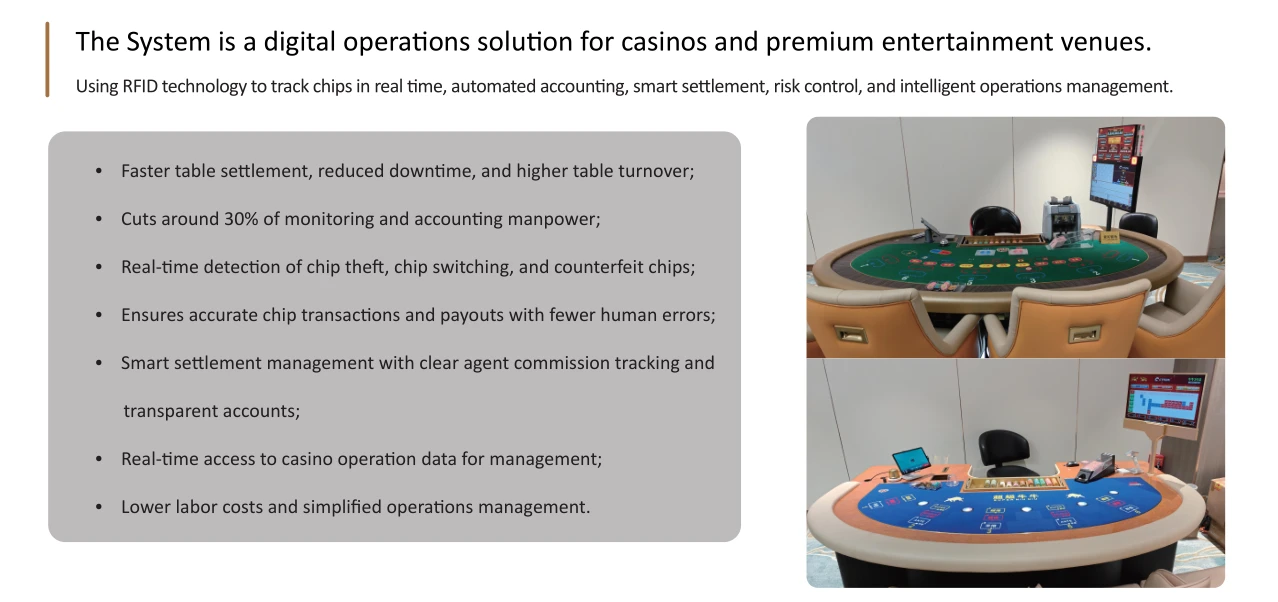
Chip shrinkage — the difference between expected and actual chip inventory — represents one of the most significant controllable losses in casino operations. Industry estimates place annual chip shrinkage at 1-3% of total chip inventory value across the average casino, translating to losses of $50,000 to $500,000 per property annually depending on size and chip volume. Traditional loss prevention approaches rely on manual observation, periodic counts, and surveillance review, but these methods cannot prevent shrinkage in real time. RFID-equipped gaming tables address chip loss at its source, providing continuous monitoring, immediate detection, and actionable intelligence that dramatically reduce shrinkage across the casino floor.

Understanding Chip Shrinkage Sources

Chip shrinkage originates from several distinct sources, each presenting different prevention challenges:

**Unintentional chip loss** accounts for approximately 40% of total shrinkage. Chips fall off tables, become mixed into discarded chip stacks, or get swept into waste containers during table cleaning. These losses are typically small — one or two chips at a time — but accumulate significantly over months of operation.

Casino Chip Loss Prevention RFID Tables Reduce Shrinkage

**Dealer error** contributes another 30% of shrinkage. Dealers may miscount payouts, overlook chips during collection, or incorrectly record chip movements. Errors increase during busy periods, high-limit games, and shift changes when dealers are under time pressure.

**Internal theft** — including chip embezzlement by staff and player collusion with dealers — represents approximately 20% of total shrinkage. This category includes schemes such as “chipping” (secretly removing chips from play), “float” (passing chips between player and dealer without game action), and “short pays” (paying a player less than the correct amount and keeping the difference).

**External theft** — including counterfeit chips and player cheating — accounts for the remaining 10%. Counterfeit chips have become increasingly sophisticated, and even experienced cage staff can miss well-made fakes.

RFID tables address all four shrinkage sources simultaneously by creating a complete, real-time record of every chip movement on the gaming floor.

Real-Time Chip Monitoring

The most immediate benefit of RFID tables is real-time chip monitoring. Every chip that enters or leaves a betting zone is read, identified, and logged with a timestamp. When a chip moves from the table to the dealer’s tray, the system records the movement. When the dealer places chips in the drop box, the system records the movement again. The result is an unbroken chain of custody from the moment a chip enters play until it returns to the cage.

This monitoring prevents unintentional loss in several ways. First, the system immediately flags chips that disappear from expected zones. If a player’s chip stack drops below the expected count without a corresponding movement to another zone, an alert is generated. Second, the system’s data enables rapid recovery of accidentally lost chips. When a chip is discovered in a floor sweep or waste container, its last-known location and timestamp can be retrieved from the database, identifying how and when it was lost.

The monitoring also serves as a powerful deterrent. Dealers and players who know that every chip movement is recorded are significantly less likely to attempt theft or manipulation. Surveillance teams can access RFID data in real time, comparing it against video feeds to verify that chip movements match the game action.

Payout Accuracy and Dealer Error Reduction

Dealer error in payouts is one of the largest single sources of chip shrinkage. On a fast-paced baccarat or Niu Niu table, a dealer may resolve 60-100 betting decisions per hour. Even with a 99% accuracy rate, 1-2 errors per hour accumulates to significant daily variance.

RFID tables eliminate dealer payout errors by providing real-time payout calculations. When a round resolves, the system calculates the exact payout based on the chips sensed in each betting zone and the game result entered by the dealer. The calculated payout displays on a dealer-facing screen, allowing the dealer to verify before distributing chips.

This approach catches two types of errors. Underpayment errors — where the dealer pays less than the correct amount — are identified immediately because the system displays the full calculated payout. Overpayment errors — where the dealer pays more than the correct amount — are caught because the system flags any chip movement that exceeds the calculated payout amount.

Casinos that have deployed RFID tables report 40-60% reductions in dealer payout errors, with the largest improvements occurring on high-limit tables where payout amounts are largest and the impact of errors is most significant.

Casino Chip Loss Prevention RFID Tables Reduce Shrinkage

Chip Float and Internal Theft Detection

Chip float schemes — where a dealer passes chips to a confederate player without a corresponding game action — are among the most difficult internal theft methods to detect through traditional surveillance. The chip float occurs in a fraction of a second, and the dealer and player coordinate their actions to avoid detection.

RFID tables detect float schemes through anomaly detection algorithms. The system monitors every chip movement and flags any transfer that does not correspond to a valid game action. If chips move from a player zone to the dealer tray but no betting decision is recorded for that player in the preceding round, the movement generates an immediate alert.

More sophisticated detection uses pattern analysis. The system builds behavioral profiles for each dealer and player, tracking metrics such as chip movement frequency, unusual timing patterns, and zone-to-zone transfers that deviate from normal game flow. When patterns suggest potential collusion, the system generates a priority alert for surveillance review.

The detection capabilities extend to short-pay schemes. In a short-pay scheme, a dealer pays a winning player correctly but records a smaller payout in the table’s chip movement log, keeping the difference. RFID tables eliminate this scheme because the system records the exact chips distributed to each player, preventing the dealer from falsifying the payout record.

Counterfeit Chip Detection

Counterfeit chips represent a growing threat to casino revenue. Modern counterfeiting techniques can produce chips that are virtually indistinguishable from authentic casino chips to the naked eye, and even experienced cage staff can be deceived. A single counterfeit chip exchanged for cash at the cage can represent a $100 or $500 loss to the casino.

RFID provides a first line of defense against counterfeits. Every chip issued by a casino carries a unique RFID tag with encoded data that cannot be replicated without access to the casino’s tag encoding system. When a chip is read at the cage or table, the system verifies the tag against the database. Unrecognized tags — or tags with encoding patterns that do not match the casino’s configuration — generate immediate alerts.

The verification happens at multiple points. At the cage window, incoming chips are verified against the database before exchange. At the table, chips entering play are verified before being placed in active zones. The multi-point verification ensures that counterfeits are caught before they can be converted to cash.

Advanced systems use cryptographic authentication in the RFID tags. Tags encoded with encrypted identifiers can be verified through a challenge-response protocol that proves the tag is authentic without revealing the encryption key. This prevents even sophisticated attackers from cloning tags by capturing and replaying the tag data Macaumr Gaming Technology.

Shrinkage Analytics and Prevention Programs

Beyond real-time detection, RFID chip tracking data enables shrinkage analytics that identify patterns, trends, and systemic issues. The system can generate reports on:

– **Table-level shrinkage rates:** Identifying tables with consistently high variance for investigation.
– **Shift-level patterns:** Detecting whether shrinkage is concentrated at specific shift times, suggesting specific staff or player patterns.
– **Denomination analysis:** Determining whether shrinkage is concentrated in specific denominations, indicating targeted theft or handling issues.
– **Variance trending:** Tracking shrinkage over time to measure the effectiveness of loss prevention initiatives.

These analytics transform loss prevention from a reactive function — responding to discovered incidents — into a proactive program that identifies and addresses systemic vulnerabilities before they result in significant losses.

Return on Investment for Chip Loss Prevention

The ROI case for RFID loss prevention is compelling. A property with $10 million in active chip inventory experiencing 2% annual shrinkage loses $200,000 per year to chip loss. Even a 50% reduction in shrinkage — achievable through RFID deployment on high-limit and high-traffic tables — saves $100,000 annually. For larger properties with higher chip volumes, the savings scale proportionally.

The investment in RFID tables includes hardware (antenna arrays, sensor boards, readers at each table), software (inventory and analytics platforms), and staff training. For a 50-table property, total deployment costs typically range from $1.5 million to $2.5 million, with annual maintenance and support adding $150,000 to $250,000. At a 50% shrinkage reduction rate, the payback period is 18-24 months, with ongoing annual savings that significantly exceed ongoing costs.

Frequently Asked Questions

How quickly can RFID tables detect chip loss compared to traditional methods?

RFID tables detect chip loss in real time — within seconds of the loss occurring. Traditional methods typically discover chip loss during periodic counts, which may occur daily, weekly, or monthly depending on the casino’s procedures. By the time a traditional count reveals a variance, the chips are long gone and the opportunity for immediate recovery has passed. RFID detection enables immediate response, including locking down tables and interviewing staff before the chips leave the property.

Can RFID systems distinguish between chips that are lost versus stolen?

The system records the exact chain of custody for every chip. If a chip moves to an unauthorized location — such as an exit or an employee’s personal bag — the system logs the movement and generates an alert. This enables security teams to respond immediately. For chips that are simply lost (dropped on the floor, swept into waste), the system provides last-known location data that can support recovery. The distinction between loss and theft is determined by the movement pattern, not by the system itself.

Does RFID eliminate the need for physical chip counts?

Physical counts remain a compliance requirement in most jurisdictions, but RFID technology transforms how they are conducted. The RFID system provides a continuous count that can be verified against the physical count. Discrepancies between the RFID count and the physical count indicate either RFID system issues (which can be diagnosed and corrected) or physical count errors. Over time, casinos report that the need for full physical counts diminishes as RFID data provides continuous confidence in inventory accuracy.

What is the typical shrinkage reduction achieved after deploying RFID tables?

Casinos deploying RFID tables report shrinkage reductions of 40-70%, with the variation depending on the property’s prior shrinkage levels, the scope of deployment (high-limit only vs. full floor), and the maturity of the analytics program. Properties with higher prior shrinkage see larger initial reductions. As the analytics program matures and loss prevention processes are refined, shrinkage rates typically stabilize at 60-80% below pre-deployment levels.

Can RFID systems prevent chip loss from player cheating, such as edge sorting or past posting?

RFID systems address chip-related cheating but not all forms of player advantage play. Edge sorting (manipulating card orientation) and past posting (adding bets after outcomes are known) are card-handling issues that RFID does not directly address. However, RFID does prevent chip-related cheating such as surreptitious bet increases and chip stripping, which are often combined with other advantage play techniques. The comprehensive approach of RFID — combined with traditional surveillance and game protection — creates a defense-in-depth strategy.

Slot Machine Financing and Funding Options for Casino Operators

Acquiring slot machines requires significant capital, and how that capital is sourced affects everything from cash flow to ownership structure to long-term profitability. Casino operators have more financing options than many realize, ranging from traditional bank lending to manufacturer captive finance to specialized gaming equipment lenders. This guide surveys the financing landscape, compares options across key dimensions, and provides a framework for selecting the optimal funding structure.

The Capital Challenge in Slot Machine Acquisition

A mid-sized casino expanding by 50 machines faces an upfront capital requirement of $750,000 to $1.5 million depending on equipment specifications. For new ventures, the challenge is even greater: a 200-machine startup casino requires $3 million to $6 million in equipment capital alone, before facility, licensing, staffing, and working capital costs.

Traditional bank lending for gaming equipment can be challenging. Many banks remain conservative about gaming industry lending due to regulatory complexity, cash-intensive operations, and reputational considerations. Operators who understand the full range of financing alternatives can access capital on better terms than those who limit themselves to conventional channels.

Financing Option Comparison

Traditional Bank Loans

Bank loans offer competitive interest rates for well-qualified borrowers but involve extensive documentation requirements, personal guarantees, and collateral requirements that may extend beyond the equipment being financed.

**Typical terms:** 3 to 7 year amortization, 300 to 600 basis points above prime depending on credit quality, 20 to 30 percent down payment.

**Advantages:** Lowest interest rates among financing options, predictable payment schedules, builds traditional credit history.

**Disadvantages:** Lengthy approval process (4 to 12 weeks), extensive documentation requirements, may require real estate or other collateral beyond equipment, limited flexibility for early payoff or restructuring.

**Best for:** Established operators with strong financial statements, substantial collateral, and predictable capital needs.

Slot Machine Financing Funding Options Casino Operators

Manufacturer Captive Finance

Major slot machine manufacturers including Aristocrat, IGT, and Light & Wonder offer financing through captive or affiliated finance arms. These programs understand gaming equipment as collateral better than traditional lenders and structure terms around equipment lifecycle considerations.

**Typical terms:** 2 to 5 year terms, rates competitive with or slightly above bank rates, 10 to 20 percent down payment, equipment serves as primary collateral.

**Advantages:** Streamlined approval relative to bank lending, flexible end-of-term options including equipment refresh and trade-in, financing integrated with purchase process.

**Disadvantages:** Limited to that manufacturer’s equipment, may bundle financing with purchase in ways that reduce price transparency, rate may be higher than bank financing for top-tier credits.

**Best for:** Operators purchasing predominantly from a single manufacturer, seeking integrated purchase and financing, or with credit profiles that benefit from equipment-focused underwriting.

Specialized Gaming Equipment Lenders

A niche lending sector has developed specifically for gaming equipment financing. These lenders understand slot machine valuation, secondary market liquidity, and gaming industry economics, enabling them to underwrite loans that generalist lenders would decline.

**Typical terms:** 2 to 5 year terms, rates 400 to 800 basis points above prime, 15 to 25 percent down payment, equipment-focused collateral.

**Advantages:** Industry expertise enables lending to credits that banks decline, faster approval (1 to 4 weeks), flexible structures including seasonal payment schedules, understands used and refurbished equipment as collateral.

**Disadvantages:** Higher interest rates than bank lending, may require more frequent reporting and covenants, smaller lenders may have limited capacity for very large transactions.

Slot Machine Financing Funding Options Casino Operators

**Best for:** Independent operators, route operators, new ventures, and operators purchasing used equipment that banks may not finance.

Equipment Leasing as Financing

Equipment leasing functions as a financing alternative with different accounting and tax treatment than loan-based financing. Operating leases keep debt off the balance sheet while capital leases build toward ownership.

**Typical terms:** 3 to 5 year lease terms, monthly payments 2 to 3 percent of equipment value, end-of-term purchase options typically 10 to 20 percent of original value.

**Advantages:** Preserves bank credit lines for other uses, operating lease payments fully deductible as operating expenses, technology refresh options at lease end, lower upfront cash requirement than purchase.

**Disadvantages:** Higher total cost than cash purchase or bank-financed purchase over full term, no depreciation benefits for operating leases, early termination penalties can be substantial.

**Best for:** Operators seeking balance sheet management, those in rapid growth phases with constrained capital, and venues with uncertain long-term equipment needs.

SBA and Government-Backed Loans

In the United States, Small Business Administration (SBA) 7(a) and 504 loan programs can finance gaming equipment for qualifying businesses. These programs provide government guarantees that enable lending terms unavailable through conventional channels.

**Typical terms:** 7 to 25 year terms for 504 loans (real estate and equipment combined), 7(a) loans up to 10 years for equipment, rates typically prime plus 200 to 300 basis points, 10 to 20 percent down payment.

**Advantages:** Longest terms available, competitive rates, lower down payment requirements than conventional lending.

**Disadvantages:** Extensive documentation and approval process (8 to 16 weeks), personal guarantee typically required, SBA eligibility requirements may exclude certain gaming business models, loan caps may limit utility for larger projects.

**Best for:** Small to mid-sized operators meeting SBA eligibility criteria, particularly those combining equipment financing with real estate acquisition or facility improvements.

Financing Strategy: Matching Structure to Circumstance

The optimal financing strategy depends on operator profile and objectives:

**Startup casinos** benefit from manufacturer captive finance or specialized gaming lenders who understand startup economics and can structure flexible early-period payments. Revenue share arrangements with equipment suppliers reduce upfront capital requirements and transfer performance risk during the ramp-up phase.

**Expanding established operators** with strong financials should compare bank lending against manufacturer finance. The bank’s lower rate may be offset by the manufacturer’s faster process and flexible end-of-term options. Request competitive quotes from both channels.

**Equipment refresh cycles** are best funded through operating leases or manufacturer trade-in programs that align financing terms with equipment replacement cycles. Avoid 5-year loans for machines that will be replaced in 3 years.

**Used equipment purchases** often require specialized gaming lenders, as traditional banks may not finance used gaming equipment or may apply aggressive depreciation that limits loan amounts. Specialized lenders understand used equipment valuation and structure loans accordingly.

Preparing for the Financing Process

Well-prepared operators secure better terms. Before approaching lenders:

**Financial documentation package:** Three years of financial statements (tax returns and internally prepared statements), current interim financials, detailed equipment schedule with specifications and pricing, business plan or expansion justification, and personal financial statements for guarantors.

**Equipment valuation support:** For used equipment purchases, provide supplier quotes, independent appraisals if available, and comparable market data supporting the valuation. Lenders unfamiliar with gaming equipment rely on this documentation for underwriting.

**Revenue projections:** Model the expected revenue contribution of the new machines using conservative assumptions. Lenders evaluate debt service coverage — projected additional net income divided by projected additional debt payments — with ratios of 1.25x or higher preferred.

**Regulatory documentation:** Demonstrate that the planned equipment purchase complies with jurisdictional requirements and that necessary licenses and approvals are in place or in process. Regulatory uncertainty increases lender risk perception.

Frequently Asked Questions

Can I finance both new and used slot machines?

Yes, though lender appetite varies. Manufacturer captive finance typically only covers their new equipment. Specialized gaming lenders finance both new and used equipment with loan-to-value ratios reflecting equipment age and condition — typically 70 to 80 percent for Grade A refurbished, 50 to 65 percent for lower grades.

How do lenders value slot machines as collateral?

Lenders typically value slot machines using a combination of original cost, age-based depreciation schedules, and secondary market comparable data. Depreciation assumptions range from 5 to 10 year straight-line for electronics-heavy equipment. Lenders may require periodic inventory verification and condition reports during the loan term.

What happens if I default on slot machine financing?

Default consequences depend on the financing structure. Secured lenders can repossess equipment and sell it to recover their loan balance. Deficiency judgments may apply if sale proceeds are insufficient. Revenue share and operating lease arrangements typically include cure periods and, upon default, equipment return with potential early termination charges. Always understand default provisions before signing — they vary significantly between lenders and structures.

How Poker Analyzer Systems Read Barcode Marked Cards in Real Time

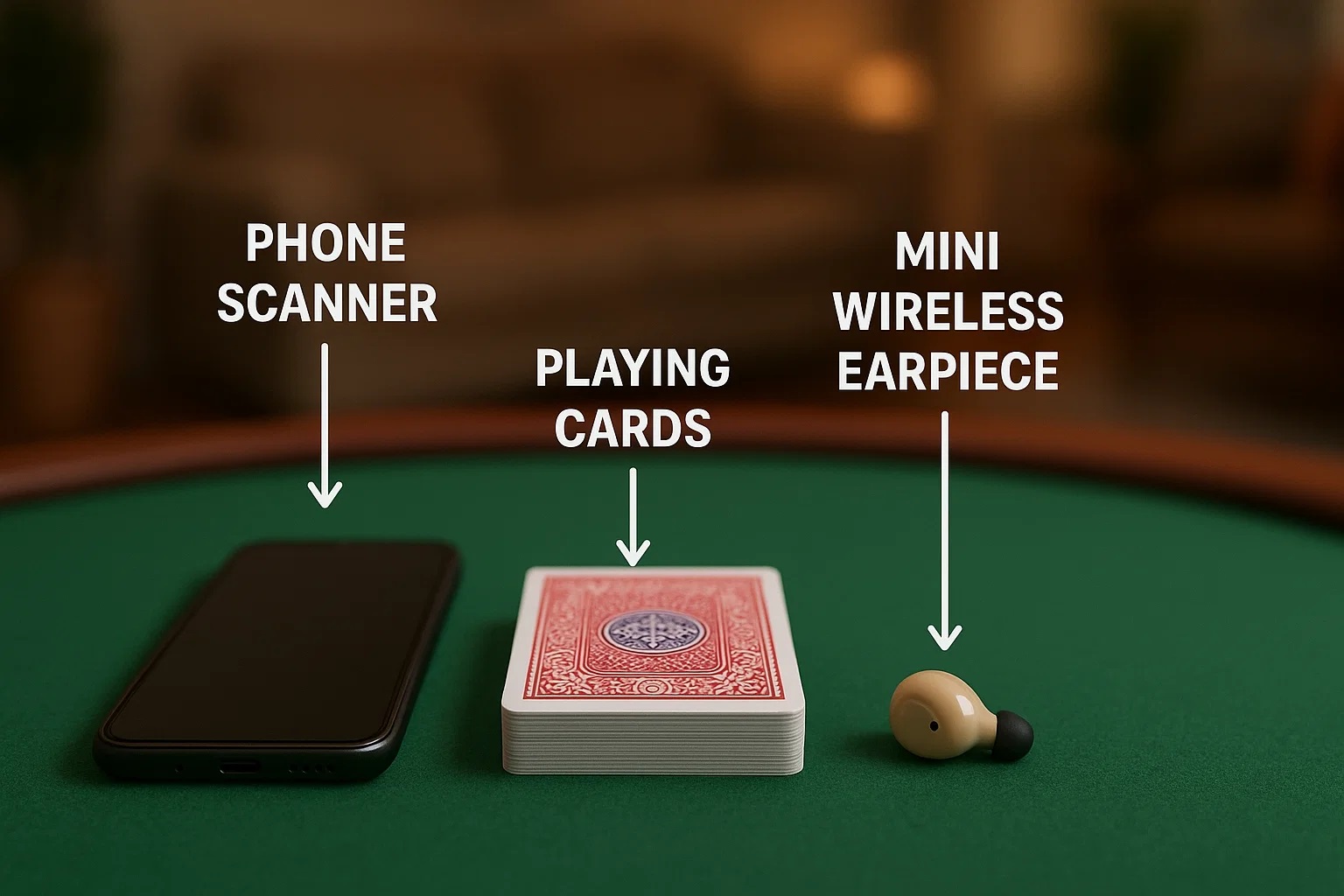
Poker analyzer systems represent one of the most sophisticated applications of optical scanning and real-time data processing in the gaming industry. Understanding how these systems read barcode marked cards and deliver results in a fraction of a second requires examining the entire signal chain—from the moment a scanning camera captures invisible edge barcodes to the instant an audio signal reaches a concealed earpiece. This article breaks down every stage with technical details, practical setup considerations, and honest assessments of system capabilities and limitations.

Barcode Marking System on Playing Cards

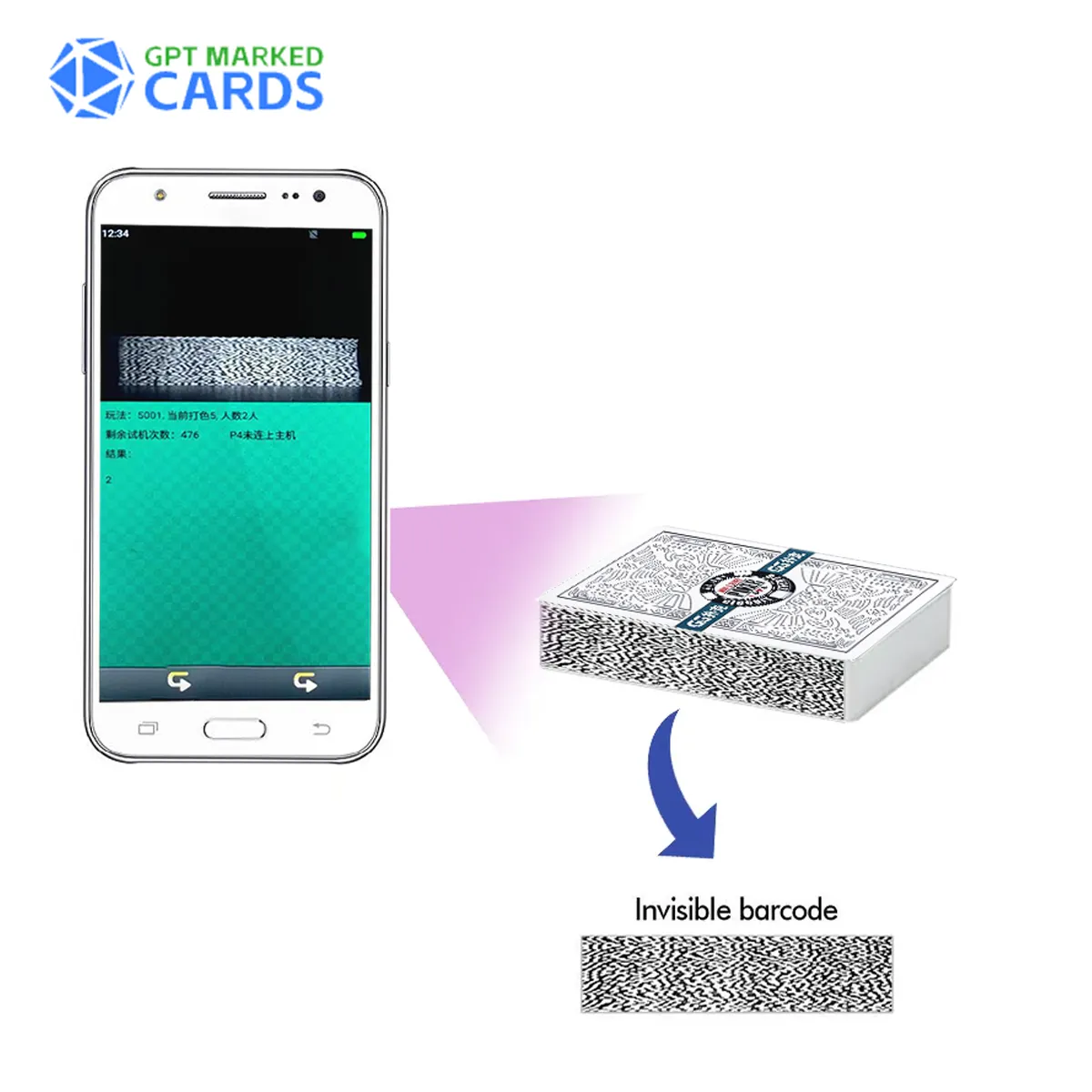
Barcode marked cards differ fundamentally from older infrared or visible-luminous marked cards. Instead of ink patterns visible under special filters, barcode marked cards carry machine-readable data strips printed along the card edges. These barcodes encode the card’s suit and rank using proprietary encoding schemes that vary between manufacturers (CVK, AKK each use different barcode formats).

Poker Analyzer Systems Read Barcode Marked Cards Real

The barcode is printed with special ink that appears invisible under normal lighting but reflects light in a specific wavelength band the poker scanning camera detects. Typical barcode dimensions on a standard poker-size card (2.5 × 3.5 inches) range from 2–4 mm in width per stripe, with the full strip occupying 15–20 mm along the edge. All four edges carry redundant copies of the same data, dramatically improving read reliability when cards are held at various angles.

A single card’s barcode contains 8–12 bits: enough to uniquely identify all 52 standard playing cards. The encoding follows a binary scheme where dark and light stripe transitions represent 1s and 0s, analogous to simplified Code 128—but adapted for the short strip length on a card edge.

The Scanning Camera: Capturing Edge Barcodes

The poker scanning camera is a miniaturized optical module designed for barcode edge reading, with specifications differing significantly from standard cameras.

Core Optical Parameters

Sensor resolution: 640 × 480 to 1280 × 720 pixels (VGA to HD)
Frame rate: 30–60 fps continuous scanning
Lens focal length: 3–6 mm, optimized for 20–80 cm scanning distance
IR filter: Tuned to 850 nm or 940 nm (matching barcode ink reflectivity)
Min illumination: 0.1–0.5 lux (reads in dim casino lighting)
Scanning angle: 60–90° FOV; best reliability within ±15° of perpendicular alignment

Each frame undergoes on-board preprocessing: edge detection isolates the barcode strip, contrast enhancement normalizes stripe transitions, and binary threshold conversion produces a clean digital pattern for decoding.

Scanner Placement Options

| Placement | Range | Concealment | Battery | Use Scenario |
|—|—|—|—|—|
| Phone case | 20–40 cm | High | Moderate (shared) | Casual games, mobile |
| Watch | 15–30 cm | Very high | Low (4–6 hrs) | Tournament, close-range |
| Car key | 15–25 cm | Very high | Low (2–4 hrs) | Short sessions |
| Lighter | 20–35 cm | High | Low (3–5 hrs) | Outdoor/smoking games |
| Table dispenser | 40–80 cm | Moderate | High (ext. power OK) | Fixed-position, long sessions |
| Belt buckle | 25–50 cm | High | Moderate (6–8 hrs) | Standing/seated games |

Phone case scanners are most popular—they leverage the natural presence of a phone on the table. The camera sits in the case edge, positioned to scan cards when the phone faces the dealing area. Watch scanners embed ultra-miniaturized cameras in the bezel—exceptional concealment but limited to 4–6 hours on a 150–300 mAh battery. Table dispensers offer the widest range (up to 80 cm) and can run on external power but require pre-game setup.

Poker Analyzer Systems Read Barcode Marked Cards Real

Decoding Process: From Barcode to Card Identity

Step 1: Barcode Pattern Extraction

The preprocessing module outputs a binary stripe pattern. A pattern-matching algorithm compares this against internal lookup tables for known encoding schemes. The system auto-detects the barcode format (CVK, AKK, or other) by attempting multiple interpretations and selecting the one producing a valid 52-card identity. Auto-detection completes in 5–10 ms on ARM processors (Cortex-A7/A53 at 800–1200 MHz).

Step 2: Card Identity Resolution

The decoded binary value maps to a specific card via a deterministic array lookup—essentially instantaneous. Value 27 might map to “King of Hearts.”

Step 3: Game Logic Processing

The identified card enters the game logic module based on active mode:

Texas Hold’em: Calculates winning probabilities for hand combinations
Omaha: Similar with four hole cards
Blackjack: Card counting and optimal action recommendations
Baccarat: Road map prediction from dealt card sequences

This is the most computationally intensive step. Poker probability calculations take 30–80 ms depending on variant and unknown cards remaining.

Step 4: Result Formatting and Transmission

The output is encoded as a tone sequence, voice announcement, or numeric code and transmitted to the earpiece. Signal transmission adds 5–15 ms.

The 0.1-Second Response Time: Latency Breakdown

| Processing Stage | Typical Latency | Range |
|—|—|—|
| Camera frame capture | 16–33 ms | 30–60 fps dependent |
| Image preprocessing | 10–20 ms | Varies with lighting |
| Barcode format detection | 5–10 ms | Nearly constant |
| Card identity lookup | <1 ms | Constant | | Game logic calculation | 30–80 ms | Varies by mode | | Audio signal transmission | 5–15 ms | Earpiece type dependent | | Total | 70–160 ms | 0.07–0.16 seconds |

Under ideal conditions—good lighting, perpendicular alignment, minimal card motion, simple game mode—latency can reach 80–100 ms, matching the advertised 0.1s spec. Real-world factors often add latency:

Poor card alignment: Multiple frame attempts add 30–60 ms each
Low lighting: Increases preprocessing by 10–30 ms
Card motion: Forces wait for stable frame (+16–33 ms per frame)
Complex game modes: Push game logic toward 80 ms upper bound

Realistic expectation: 0.1–0.2 seconds in typical conditions, occasionally 0.3 seconds when scanning is suboptimal.

Signal Transmission to Earpiece

RF transmission: Most common method. The analyzer transmits a short-range RF signal (400–470 MHz or 2.4 GHz) to a matched receiver. RF is extremely fast (<5 ms) and reliable within 1–3 m. No Bluetooth pairing—factory-matched frequency. Bluetooth transmission: Newer models support Bluetooth audio output to compatible earbuds. Adds 10–20 ms latency but works with ordinary commercial earbuds for perfect visual concealment.

The RF vs Bluetooth choice affects latency by 5–15 ms—not dramatic, but relevant for users seeking absolute fastest response.

Practical Setup Instructions

1. Charge all components fully before the session. Depleted scanner batteries cause most missed reads.
2. Select correct barcode format in settings. CVK cards need CVK format; AKK cards need AKK. Most current systems auto-detect, but verify to prevent errors.
3. Position the scanning camera at appropriate distance and angle. Phone case: lay flat with scanner edge facing card zone. Watch: orient wrist for clear line of sight to card edges. Practice positioning before actual games.
4. Select correct game mode. Wrong mode produces incorrect probability outputs.
5. Test earpiece before entering the game. Confirm audio output and adjust volume to audible-but-imperceptible levels.
6. Verify card readability by scanning test cards from the marked deck in a controlled setting.

System Limitations and Caveats

Barcode readability degrades with bent, creased, or damaged card edges. A damaged edge may lose barcode integrity, forcing reads from other edges that may not be scanner-visible.
Lighting conditions matter. Extremely dark (<0.1 lux) or strong IR sources (some security cameras) reduce reliability. - Card alignment is critical. Cards with edges parallel to the scanner are nearly impossible to read. At least one edge must be at a visible angle.
Battery life is finite. Continuous scanning consumes significant power. Watch scanners may exhibit reduced frame rates after 5+ hours.
Multiple units in the same room can interfere if using the same RF frequency—rare but possible.
Cards are read one at a time. The system cannot simultaneously scan an entire spread hand. Each card must pass through the scanner’s FOV individually.

Scanner Module Specifications Comparison

| Spec | CVK 600 | CVK 700 | AKK A3 | AKK A5 |
|—|—|—|—|—|
| Sensor | 720 × 480 | 1280 × 720 | 640 × 480 | 1280 × 720 |
| Frame rate | 30 fps | 60 fps | 30 fps | 50 fps |
| Range | 20–40 cm | 25–55 cm | 15–35 cm | 15–35 cm |
| IR wavelength | 850 nm | 850 nm | 940 nm | 850 nm |
| Processor | 800 MHz | 1.2 GHz | 800 MHz | 1 Custom Playing Cards.0 GHz |
| Barcode support | CVK only | CVK + AKK auto | AKK only | AKK + CVK auto |
| Power draw | 120 mA | 180 mA | 100 mA | 150 mA |
| Dimensions | 35×20×8 mm | 40×22×10 mm | 30×18×7 mm | 38×20×9 mm |
| Weight | 12 g | 18 g | 10 g | 15 g |

The CVK 700 and AKK A5 represent current-generation hardware with higher resolution, faster frame rates, and dual-format auto-detection. Older modules remain functional but are format-locked and have shorter ranges.

FAQ

Q: How fast does a poker analyzer actually read a barcode marked card?
A: Under optimal conditions, total scan-to-result time is 0.07–0.1 seconds (70–100 ms). In typical real-world conditions, 0.1–0.2 seconds, with occasional delays to 0.3 seconds if multiple frame attempts are needed.

Q: Can the scanner read cards from any angle?
A: No. The camera needs a view of at least one card edge where the barcode is visible and reasonably perpendicular (±15°). Cards stacked flat with edges parallel to the scanner are difficult or impossible to read.

Q: Do different brands of marked cards work with any analyzer?
A: Compatibility depends on barcode format. CVK and AKK use different encodings. Older models support only their own format. Current-generation analyzers (CVK 700, AKK A5) auto-detect both, but confirm compatibility before purchasing marked cards.

Q: What happens if a card’s edge barcode is damaged?
A: The scanner attempts other visible edges (most marked cards carry redundant barcodes on multiple edges). If all edges are damaged or invisible from the scanner’s position, that card cannot be read. Card condition maintenance is important for reliable operation.

Q: How much does lighting affect scanning performance?
A: The IR filter and low-lux sensor allow reading in most indoor conditions including dim casinos. Extremely dark environments (<0.1 lux) or strong competing IR illumination reduce reliability. Normal indoor lighting (10–500 lux) provides optimal conditions.

Texas Hold’em Poker Analyzer: Real-Time Hand Reading Explained

Texas Hold’em is the most popular poker variant in the world and, not coincidentally, the game for which poker analyzers are most extensively optimized. The game’s unique structure — two private hole cards plus five community cards revealed in stages — creates the perfect scenario for real-time analysis. Understanding how poker analyzers process Texas Hold’em specifically, and how the visualization tablet elevates multi-player awareness, is essential for anyone considering an analyzer investment.

Why Texas Hold’em Is Ideal for Analyzer Use

Several characteristics of Texas Hold’em make it particularly well-suited to analyzer technology compared to other poker variants.

The two-card starting hand structure means the analyzer only needs to read two barcode cards per player. With nine or ten players at a full table, the scanner captures 18 to 20 hole cards in approximately two seconds of total scanning time. This rapid initial read establishes the complete pre-flop landscape before any betting action begins.

Texas Hold em Poker Analyzer Real Time Hand

The progressive community card revelation — flop, turn, river — creates natural analysis stages where hand probabilities shift dramatically. The analyzer recalculates winning probabilities at each stage, providing updated information exactly when the player needs to make critical decisions. This staged structure aligns perfectly with how the analyzer software processes information.

Perhaps most importantly, Texas Hold’em’s community cards are visible to everyone. The analyzer does not need to read community cards from barcodes — the software knows which cards appear on the board because the player can input them manually or the analyzer can deduce them from the known hole cards and standard deck composition.

Pre-Flop Analysis: The Information Advantage

The pre-flop stage is where the poker analyzer provides its most dramatic advantage. Before any community cards are revealed, the analyzer has already read every player’s hole cards and calculated the exact winning probabilities.

This information transforms pre-flop decision-making. Rather than estimating hand strength based on starting hand charts and position, the player knows precisely where their hand ranks among all hands at the table. A pair of Kings is a strong starting hand in isolation — but if another player holds Aces, the analyzer reveals this before a single chip enters the pot.

The analyzer also identifies situations where multiple players hold strong but second-best hands. When three players hold premium starting hands, the analyzer recognizes the potential for a massive pot — and advises caution to the player holding the weakest of the three strong hands.

Community Card Integration

As the dealer reveals community cards, the analyzer continuously updates its calculations. This dynamic analysis is far more sophisticated than simple pre-flop hand ranking.

When the flop appears, the analyzer recalculates every player’s hand strength incorporating the three community cards. A seemingly weak starting hand may suddenly become the favorite after connecting with the flop. The player with top pair hears their status change from underdog to favorite in real time.

The turn and river each trigger further recalculation. The analyzer tracks not just current hand strength but also drawing potential — how many outs each player has to improve, and the probability of those outs appearing. This forward-looking analysis helps the player anticipate rather than react to changing hand dynamics.

The Visualization Tablet System

For Texas Hold’em played with the visualization tablet accessory, the analyzer’s output transcends simple audio announcements and delivers comprehensive visual awareness.

Texas Hold em Poker Analyzer Real Time Hand

The visualization tablet is a dedicated display device that shows a graphical representation of the poker table with every player’s hole cards visible. Looking at the tablet is like seeing the game from a spectator’s perspective with all cards revealed — except the spectator knows the outcome before anyone at the table.

The tablet displays each player position with their two hole cards shown face-up. As community cards are dealt, they appear on the virtual board. The software highlights the current winning hand and ranks all other hands from strongest to weakest. Probability percentages update in real time as each new community card is revealed.

The tablet system supports multiple simultaneous tables, allowing one person to monitor several games at once. In environments where an observer can watch the tablet from a separate location, the player at the table receives audio-only updates while the observer sees the full visual picture and can communicate additional information through subtle signals Custom Playing Cards.

Multi-Player Hand Prediction

Beyond simply identifying the current winning hand, advanced analyzer software predicts how hands will develop as additional community cards appear. This predictive capability enables strategic planning several betting rounds ahead.

For example, the analyzer might report: “Player 3 currently leads with top pair, but Player 7 has an open-ended straight draw with eight outs. If a 7 or Queen appears on the turn, Player 7 becomes the favorite.” This level of detail allows the player to size bets based not just on current hand strength but on the probability that their opponent will improve.

The analyzer also identifies situations where no player has yet made a strong hand — the “no one has anything” scenario. In these situations, aggression often wins the pot regardless of actual hand strength, and the analyzer’s confirmation that opponents are equally weak emboldens the player to seize control of the betting.

Texas Hold’em vs Other Game Types

While poker analyzers support multiple game formats, Texas Hold’em remains the flagship application. Comparing Hold’em analysis to other game types illustrates why.

**Omaha** analysis is more complex due to the four-card starting hand and the requirement to use exactly two hole cards with three community cards. The analyzer must evaluate all possible two-card combinations from each player’s four hole cards — six combinations per player, multiplied by the number of players. This combinatorial explosion demands more processing power but is well within modern analyzer capabilities.

**Baccarat** analysis is comparatively simple. With only two hands (Player and Banker) and predictable drawing rules, the analyzer’s main contribution is knowing the exact card sequence before it is revealed. Baccarat analysis requires less sophisticated software but still benefits from the 0.1-second scan speed.

The analyzer’s value proposition peaks in Texas Hold’em due to the combination of hidden information (hole cards), progressive revelation (community cards), and multi-player dynamics (nine or ten opponents). No other common poker variant combines these elements to the same degree.

Optimizing Analyzer Use for Hold’em

Texas Hold’em analyzer users develop techniques specific to the game’s structure that maximize the technology’s advantage.

**Pre-flop positioning.** The critical scan window occurs when hole cards are dealt and players lift their cards to view them. This is when the barcode edges are most exposed. Positioning the scanner to capture this moment ensures complete pre-flop information before betting begins.

**Community card confirmation.** While the analyzer can deduce community cards from known hole cards, manual confirmation through the software interface eliminates any possibility of error. Some players input the flop cards through discreet touch gestures on the phone screen, while others rely on the software’s deduction capability.

**Bet sizing integration.** The most sophisticated analyzer software incorporates bet sizing recommendations based on hand strength and pot odds. When the analyzer announces hand strength, it may also suggest bet sizing ranges that extract maximum value while protecting against obvious betting patterns that reveal the player’s knowledge.

Frequently Asked Questions

**Does the analyzer tell me exactly what bet to make?**
Some advanced software includes bet sizing suggestions based on hand strength and pot odds. However, betting decisions should incorporate table dynamics, opponent tendencies, and the player’s overall strategy. The analyzer provides information — the player makes decisions.

**Can the visualization tablet be detected?**
The tablet is typically used by an observer in a separate location rather than at the table by the player. When used at the table, it should be concealed or disguised. The tablet’s screen brightness is adjustable for low-visibility operation.

**How does the analyzer handle split pots?**
When two or more players hold identical winning hands, the analyzer identifies the split pot scenario and announces it accordingly. The software calculates exact pot division amounts in chip games.

**Does the analyzer work for short-handed games?**
Yes. The analyzer adapts to any number of players from heads-up to full ring. Short-handed games actually process faster since fewer cards need to be scanned.

**Can I use the analyzer for online poker?**
Poker analyzers are designed for physical card games where barcode marked cards are in play. They cannot read cards in online poker where cards are virtual and no physical scanning is possible.

AKK Poker Analyzer Series – Full Product Comparison and Review

Introduction to the AKK Series

The AKK poker analyzer series has established itself as one of the most trusted and widely deployed product lines in the poker analysis market. Built on Android smartphone platforms, AKK devices combine the familiarity of everyday mobile phones with cutting-edge scanning and analysis technology. For wholesalers and distributors, the AKK series represents a reliable, high-demand product line with models spanning entry-level to professional-grade performance poker card analyzer.

AKK Poker Analyzer Series Full Product Comparison Review

What sets AKK apart from competitors is its consistent build quality, broad game compatibility, and active firmware development. Each generation of AKK analyzers has introduced meaningful improvements in scanning accuracy, processing speed, and user experience, making the series a staple in any serious distributor’s catalog.

AKK Product Lineup — Model by Model

AKK A1 — The Entry Point

The A1 serves as the gateway into the AKK ecosystem. Housed in a standard Android smartphone shell, it delivers core analyzer functionality with a scanning distance of approximately 25 cm and a processing speed of around 0.3 seconds. The A1 supports Texas Hold’em and Omaha, covering the two most popular game types.

For distributors, the A1 is an ideal entry-level option. It appeals to first-time buyers who want to test the technology without committing to a premium device. Its straightforward interface and minimal setup requirements reduce the learning curve and after-sales support burden.

AKK A2 — Compact and Discreet

The A2 refines the A1 formula with a more compact shell design and improved scanning optics. The scanning distance extends to 30 cm, and processing time drops to approximately 0.2 seconds. The A2 also introduces support for Baccarat, expanding its utility beyond poker.

The smaller form factor makes the A2 less conspicuous at the table — a significant advantage for users who prioritize discretion. Distributors will find the A2 appeals to customers who find the A1’s shell slightly too large or who need Baccarat support alongside standard poker games.

AKK A4 — The Professional Workhorse

The A4 represents the sweet spot in the AKK lineup. It features an upgraded processing chip that delivers analysis results in 0.1 seconds, matching the industry’s top performance benchmark. The scanning distance extends to 35–40 cm, accommodating larger table configurations.

Key improvements over the A2 include a more sensitive camera sensor, better barcode decoding algorithms, and enhanced Bluetooth connectivity for more stable earpiece communication. The A4 also supports a wider range of marked deck profiles, making it compatible with more barcode encoding schemes.

For wholesale buyers, the A4 is often the strongest seller. It offers professional-grade performance at a mid-range investment level, satisfying both serious individual users and small-scale operators. Stocking the A4 in depth is rarely a mistake.

AKK A6 — The Flagship

The A6 sits at the top of the AKK product hierarchy. It incorporates the latest generation scanning hardware with a maximum effective distance of 45 cm — the longest in the AKK series. Processing speed holds at 0.1 seconds, but the A6 achieves this consistently even in challenging lighting conditions, thanks to an adaptive exposure system.

AKK Poker Analyzer Series Full Product Comparison Review

The A6 also introduces multi-camera support, allowing it to work with up to two external scanner cameras simultaneously. This redundancy ensures that if one camera angle is obstructed, the other can compensate, dramatically reducing the risk of missed scans during critical hands.

Additional features include an upgraded Bluetooth module with extended range and reduced latency, a larger display for easier menu navigation, and support for the latest deck profiles. The A6 is the model of choice for high-stakes operators who demand zero compromise.

AKK K3 and K5 — Specialized Variants

The K3 and K5 are newer additions to the AKK family that target specific market segments. The K3 focuses on streamlined operation with a simplified interface, making it accessible to users who find the full A-series feature set overwhelming. It supports Texas Hold’em and Omaha with reliable 0.15-second analysis speed.

The K5, on the other hand, emphasizes advanced analytics. Beyond simple winner prediction, it provides detailed hand analysis data, including odds calculations and positional statistics. This appeals to analytical users who want deeper game intelligence beyond a single result notification.

AKK vs. the Competition

AKK vs. CVK

The most frequent comparison in the market is AKK versus CVK. The fundamental difference is platform: AKK uses Android shells, CVK uses iPhone shells. This single distinction drives most purchasing decisions. Users who already carry Android phones gravitate toward AKK, while iPhone users prefer CVK.

Beyond platform, AKK generally offers broader game compatibility and more flexible external camera support. CVK, however, often edges ahead in Bluetooth integration quality and the aesthetic precision of its iPhone housings. For distributors, carrying both lines eliminates the need to steer customers toward a less natural platform choice.

AKK vs. CAC

The CAC analyzer competes on concealment, offering a smaller, less phone-like form factor. However, it sacrifices game variety and scanning distance to achieve that compactness. AKK’s A2 and A4 models provide a strong middle ground — reasonably discreet with significantly better performance specs.

AKK vs. LD

The LD Poker Now Analyzer undercuts AKK on investment but also delivers lower scanning distance and slower processing. AKK’s A1 sits in a similar budget tier while offering better build quality and more consistent firmware updates. For price-sensitive markets, the LD has a role, but AKK’s entry-level models often provide better long-term value.

Game Type Support Across the AKK Line

| Game Type | A1 | A2 | A4 | A6 | K3 | K5 |
|———–|—-|—-|—-|—-|—-|—-|
| Texas Hold’em | Yes | Yes | Yes | Yes | Yes | Yes |
| Omaha | Yes | Yes | Yes | Yes | Yes | Yes |
| Baccarat | No | Yes | Yes | Yes | No | Yes |
| Seca | No | No | Yes | Yes | No | No |
| Mahjong | No | No | No | Yes | No | No |

Distributors serving markets where Baccarat is popular should prioritize the A2 and above. The A6’s Mahjong support opens additional revenue channels in Asian markets.

Build Quality and Authenticity

AKK analyzers are constructed using genuine Android smartphone shells sourced from major manufacturers. This means the weight, texture, and external appearance are virtually identical to a real phone. Buttons are functional, the screen displays a normal Android interface when not in analyzer mode, and the device passes casual visual inspection.

This authenticity matters enormously for end users. A device that looks or feels wrong at the table is a liability. AKK’s commitment to genuine shells across its entire product line is one of its strongest selling points and a key reason for the brand’s sustained market presence.

Firmware and Ongoing Support

AKK regularly releases firmware updates that add new deck profiles, improve scanning algorithms, and fix minor issues. Distributors who maintain a relationship with the manufacturer can receive these updates ahead of general release, providing an after-sales service advantage.

For customers, the update process is straightforward — typically involving a file transfer to the device via USB or a wireless update mechanism. Distributors should factor firmware support into their supplier evaluation, as brands that neglect updates leave customers with increasingly obsolete hardware.

Strategic Recommendations for Distributors

Stock the A4 as your primary AKK offering. It hits the performance sweet spot that satisfies the majority of customers. Complement it with the A6 for premium buyers and the A1 for budget-conscious newcomers. The A2 and K3 serve niche needs — compactness and simplicity, respectively — and can be ordered on demand rather than stocked in depth.

Always bundle AKK analyzers with compatible marked decks and earpieces. These accessories have high margins and increase the total order value. Offering pre-configured packages (analyzer + deck + earpiece) simplifies the purchasing decision and reduces setup complaints.

FAQ

Which AKK model is the best seller?

The AKK A4 consistently ranks as the top seller across most markets. It offers professional-grade 0.1-second analysis at a mid-range price point, making it the optimal balance of performance and investment for the majority of customers.

Do AKK analyzers work with iPhone?

No. AKK analyzers are built into Android smartphone shells. Customers who need an iPhone-based device should consider the CVK series instead.

How often does AKK release firmware updates?

AKK typically releases firmware updates quarterly, with additional updates when new marked deck profiles become available. Distributors should register with the manufacturer to receive update notifications directly.

Can AKK analyzers use external scanner cameras?

Yes. The A4, A6, and K5 all support wireless external scanner cameras. The A6 supports up to two simultaneous external cameras for redundant scanning coverage.

What marked decks are compatible with AKK analyzers?

AKK analyzers work with any barcode-marked deck that matches a loaded deck profile. Most suppliers offer matched AKK-and-deck packages. Common compatible brands include Copag, Modiano, Fournier, and Bicycle, all processed with invisible edge barcodes.

Is the AKK A6 worth the premium over the A4?

For most users, the A4 provides everything they need. The A6 justifies its premium for customers who require maximum scanning distance (45 cm), dual external camera support, or Mahjong game compatibility. Distributors should stock the A6 in smaller quantities and position it as a specialist upgrade.

What is the typical learning curve for new AKK users?

Most AKK models can be set up and operational within 15 to 30 minutes. The process involves loading the deck profile, pairing the Bluetooth earpiece, and selecting the game type. AKK’s Android-based interface is generally intuitive, and most users become comfortable with operation after one or two practice sessions. Distributors should include a quick-start guide with every unit to minimize support requests PokerAnalyzerShop.

How do AKK analyzers handle firmware updates?

AKK firmware updates are delivered as installation files that can be transferred to the device via USB cable or wireless download. The update process typically takes 5 to 10 minutes and does not affect stored deck profiles or game settings. Distributors should maintain a record of which firmware version each batch of analyzers ships with, and proactively notify customers when critical updates become available.