Poker analyzer systems represent one of the most sophisticated applications of optical scanning and real-time data processing in the gaming industry. Understanding how these systems read barcode marked cards and deliver results in a fraction of a second requires examining the entire signal chain—from the moment a scanning camera captures invisible edge barcodes to the instant an audio signal reaches a concealed earpiece. This article breaks down every stage with technical details, practical setup considerations, and honest assessments of system capabilities and limitations.
Barcode Marking System on Playing Cards
Barcode marked cards differ fundamentally from older infrared or visible-luminous marked cards. Instead of ink patterns visible under special filters, barcode marked cards carry machine-readable data strips printed along the card edges. These barcodes encode the card’s suit and rank using proprietary encoding schemes that vary between manufacturers (CVK, AKK each use different barcode formats).

The barcode is printed with special ink that appears invisible under normal lighting but reflects light in a specific wavelength band the poker scanning camera detects. Typical barcode dimensions on a standard poker-size card (2.5 × 3.5 inches) range from 2–4 mm in width per stripe, with the full strip occupying 15–20 mm along the edge. All four edges carry redundant copies of the same data, dramatically improving read reliability when cards are held at various angles.
A single card’s barcode contains 8–12 bits: enough to uniquely identify all 52 standard playing cards. The encoding follows a binary scheme where dark and light stripe transitions represent 1s and 0s, analogous to simplified Code 128—but adapted for the short strip length on a card edge.
The Scanning Camera: Capturing Edge Barcodes
The poker scanning camera is a miniaturized optical module designed for barcode edge reading, with specifications differing significantly from standard cameras.
Core Optical Parameters
– Sensor resolution: 640 × 480 to 1280 × 720 pixels (VGA to HD)
– Frame rate: 30–60 fps continuous scanning
– Lens focal length: 3–6 mm, optimized for 20–80 cm scanning distance
– IR filter: Tuned to 850 nm or 940 nm (matching barcode ink reflectivity)
– Min illumination: 0.1–0.5 lux (reads in dim casino lighting)
– Scanning angle: 60–90° FOV; best reliability within ±15° of perpendicular alignment
Each frame undergoes on-board preprocessing: edge detection isolates the barcode strip, contrast enhancement normalizes stripe transitions, and binary threshold conversion produces a clean digital pattern for decoding.
Scanner Placement Options
| Placement | Range | Concealment | Battery | Use Scenario |
|—|—|—|—|—|
| Phone case | 20–40 cm | High | Moderate (shared) | Casual games, mobile |
| Watch | 15–30 cm | Very high | Low (4–6 hrs) | Tournament, close-range |
| Car key | 15–25 cm | Very high | Low (2–4 hrs) | Short sessions |
| Lighter | 20–35 cm | High | Low (3–5 hrs) | Outdoor/smoking games |
| Table dispenser | 40–80 cm | Moderate | High (ext. power OK) | Fixed-position, long sessions |
| Belt buckle | 25–50 cm | High | Moderate (6–8 hrs) | Standing/seated games |
Phone case scanners are most popular—they leverage the natural presence of a phone on the table. The camera sits in the case edge, positioned to scan cards when the phone faces the dealing area. Watch scanners embed ultra-miniaturized cameras in the bezel—exceptional concealment but limited to 4–6 hours on a 150–300 mAh battery. Table dispensers offer the widest range (up to 80 cm) and can run on external power but require pre-game setup.
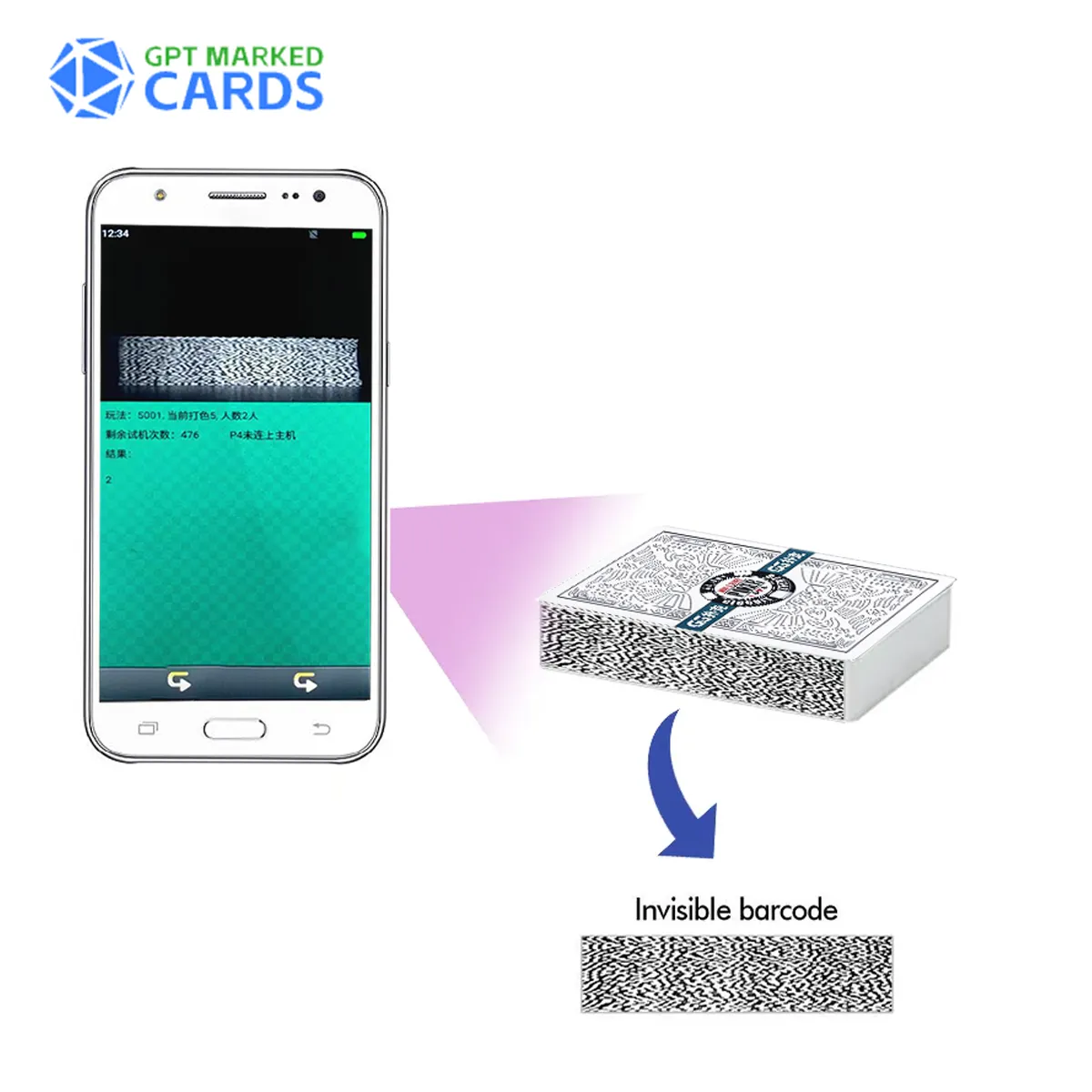
Decoding Process: From Barcode to Card Identity
Step 1: Barcode Pattern Extraction
The preprocessing module outputs a binary stripe pattern. A pattern-matching algorithm compares this against internal lookup tables for known encoding schemes. The system auto-detects the barcode format (CVK, AKK, or other) by attempting multiple interpretations and selecting the one producing a valid 52-card identity. Auto-detection completes in 5–10 ms on ARM processors (Cortex-A7/A53 at 800–1200 MHz).
Step 2: Card Identity Resolution
The decoded binary value maps to a specific card via a deterministic array lookup—essentially instantaneous. Value 27 might map to “King of Hearts.”
Step 3: Game Logic Processing
The identified card enters the game logic module based on active mode:
– Texas Hold’em: Calculates winning probabilities for hand combinations
– Omaha: Similar with four hole cards
– Blackjack: Card counting and optimal action recommendations
– Baccarat: Road map prediction from dealt card sequences
This is the most computationally intensive step. Poker probability calculations take 30–80 ms depending on variant and unknown cards remaining.
Step 4: Result Formatting and Transmission
The output is encoded as a tone sequence, voice announcement, or numeric code and transmitted to the earpiece. Signal transmission adds 5–15 ms.
The 0.1-Second Response Time: Latency Breakdown
| Processing Stage | Typical Latency | Range |
|—|—|—|
| Camera frame capture | 16–33 ms | 30–60 fps dependent |
| Image preprocessing | 10–20 ms | Varies with lighting |
| Barcode format detection | 5–10 ms | Nearly constant |
| Card identity lookup | <1 ms | Constant |
| Game logic calculation | 30–80 ms | Varies by mode |
| Audio signal transmission | 5–15 ms | Earpiece type dependent |
| Total | 70–160 ms | 0.07–0.16 seconds |
Under ideal conditions—good lighting, perpendicular alignment, minimal card motion, simple game mode—latency can reach 80–100 ms, matching the advertised 0.1s spec. Real-world factors often add latency:
– Poor card alignment: Multiple frame attempts add 30–60 ms each
– Low lighting: Increases preprocessing by 10–30 ms
– Card motion: Forces wait for stable frame (+16–33 ms per frame)
– Complex game modes: Push game logic toward 80 ms upper bound
Realistic expectation: 0.1–0.2 seconds in typical conditions, occasionally 0.3 seconds when scanning is suboptimal.
Signal Transmission to Earpiece
RF transmission: Most common method. The analyzer transmits a short-range RF signal (400–470 MHz or 2.4 GHz) to a matched receiver. RF is extremely fast (<5 ms) and reliable within 1–3 m. No Bluetooth pairing—factory-matched frequency. Bluetooth transmission: Newer models support Bluetooth audio output to compatible earbuds. Adds 10–20 ms latency but works with ordinary commercial earbuds for perfect visual concealment.
The RF vs Bluetooth choice affects latency by 5–15 ms—not dramatic, but relevant for users seeking absolute fastest response.
Practical Setup Instructions
1. Charge all components fully before the session. Depleted scanner batteries cause most missed reads.
2. Select correct barcode format in settings. CVK cards need CVK format; AKK cards need AKK. Most current systems auto-detect, but verify to prevent errors.
3. Position the scanning camera at appropriate distance and angle. Phone case: lay flat with scanner edge facing card zone. Watch: orient wrist for clear line of sight to card edges. Practice positioning before actual games.
4. Select correct game mode. Wrong mode produces incorrect probability outputs.
5. Test earpiece before entering the game. Confirm audio output and adjust volume to audible-but-imperceptible levels.
6. Verify card readability by scanning test cards from the marked deck in a controlled setting.
System Limitations and Caveats
– Barcode readability degrades with bent, creased, or damaged card edges. A damaged edge may lose barcode integrity, forcing reads from other edges that may not be scanner-visible.
– Lighting conditions matter. Extremely dark (<0.1 lux) or strong IR sources (some security cameras) reduce reliability.
- Card alignment is critical. Cards with edges parallel to the scanner are nearly impossible to read. At least one edge must be at a visible angle.
– Battery life is finite. Continuous scanning consumes significant power. Watch scanners may exhibit reduced frame rates after 5+ hours.
– Multiple units in the same room can interfere if using the same RF frequency—rare but possible.
– Cards are read one at a time. The system cannot simultaneously scan an entire spread hand. Each card must pass through the scanner’s FOV individually.
Scanner Module Specifications Comparison
| Spec | CVK 600 | CVK 700 | AKK A3 | AKK A5 |
|—|—|—|—|—|
| Sensor | 720 × 480 | 1280 × 720 | 640 × 480 | 1280 × 720 |
| Frame rate | 30 fps | 60 fps | 30 fps | 50 fps |
| Range | 20–40 cm | 25–55 cm | 15–35 cm | 15–35 cm |
| IR wavelength | 850 nm | 850 nm | 940 nm | 850 nm |
| Processor | 800 MHz | 1.2 GHz | 800 MHz | 1 Custom Playing Cards.0 GHz |
| Barcode support | CVK only | CVK + AKK auto | AKK only | AKK + CVK auto |
| Power draw | 120 mA | 180 mA | 100 mA | 150 mA |
| Dimensions | 35×20×8 mm | 40×22×10 mm | 30×18×7 mm | 38×20×9 mm |
| Weight | 12 g | 18 g | 10 g | 15 g |
The CVK 700 and AKK A5 represent current-generation hardware with higher resolution, faster frame rates, and dual-format auto-detection. Older modules remain functional but are format-locked and have shorter ranges.
FAQ
Q: How fast does a poker analyzer actually read a barcode marked card?
A: Under optimal conditions, total scan-to-result time is 0.07–0.1 seconds (70–100 ms). In typical real-world conditions, 0.1–0.2 seconds, with occasional delays to 0.3 seconds if multiple frame attempts are needed.
Q: Can the scanner read cards from any angle?
A: No. The camera needs a view of at least one card edge where the barcode is visible and reasonably perpendicular (±15°). Cards stacked flat with edges parallel to the scanner are difficult or impossible to read.
Q: Do different brands of marked cards work with any analyzer?
A: Compatibility depends on barcode format. CVK and AKK use different encodings. Older models support only their own format. Current-generation analyzers (CVK 700, AKK A5) auto-detect both, but confirm compatibility before purchasing marked cards.
Q: What happens if a card’s edge barcode is damaged?
A: The scanner attempts other visible edges (most marked cards carry redundant barcodes on multiple edges). If all edges are damaged or invisible from the scanner’s position, that card cannot be read. Card condition maintenance is important for reliable operation.
Q: How much does lighting affect scanning performance?
A: The IR filter and low-lux sensor allow reading in most indoor conditions including dim casinos. Extremely dark environments (<0.1 lux) or strong competing IR illumination reduce reliability. Normal indoor lighting (10–500 lux) provides optimal conditions.